“It’s already happening. We’re seeing it in referral traffic, and in buyer interviews people echo the same thing: AI is becoming their primary source of research.”
Presented in partnership with

The State of AEO in Marketing · AEO G2 Insights · October 2026
Buyers are moving to AI platforms faster than marketing can measure.
B2B buyers now start their research in AI answer engines, and marketing teams felt the shift before they measured it. Across 153 interviews with B2B marketing decision-makers, discovery is moving to different AI platforms like ChatGPT, Perplexity, Gemini, or AI Overviews while 3 in 4 organizations lack decision-grade visibility into how those engines represent them. This AEO G2 Insights report aims to map the general state of AEO in Marketing and analyze the gap between where discovery happens, what marketing measures and how it addresses AEO and AI search monitoring, and shows what the teams closing it do differently.
Analyst: Anubha Garg
Analyst: Aurora Martina Granata
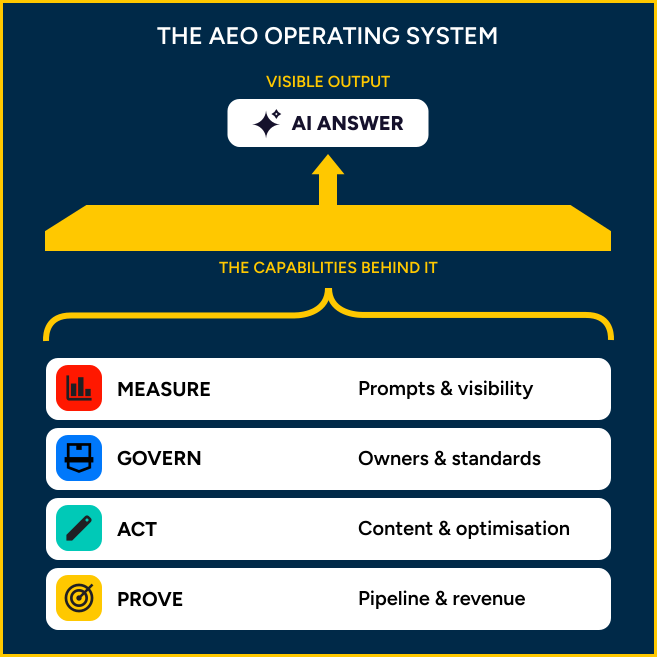
Answer engine optimization (AEO) is the practice of improving how a brand is found, represented, and recommended inside AI-generated answers.
76%say AI answer engines are becoming the first step in buyer research; 43% say AI platforms are already the primary first step.
75%operate with only partial or manual visibility into how different AI platforms represent them.
62%run AEO through fragmented multi-tool setups stitched together by hand.
44%gate further AEO investment on ROI or business-impact proof.
Executive summary
Why is organic search traffic declining even with strong SEO?
AI discovery is moving to the front of B2B buyer research faster than marketing teams measure it. Across 153 interviews, 76% said AI answer engines are becoming the first step in buyer research, and 43% said AI is already the primary first step. The organic traffic research in this study backs the shift: one in three respondents reported a measurable decline in organic search traffic over the last year, and among those decliners, 68% attribute it at least partly to buyers moving to AI answer engines.
Measurement has not kept pace. According to the AEO insights collected by G2, 75% of organizations still operate with only partial or manual visibility into how AI answer engines represent them, and only 17% run tool-based monitoring they would base decisions on. Teams are not waiting for the category to standardize: 62% already run AEO through fragmented but functioning multi-tool setups, and half anchor AI prompt selection in buyer search. Governance lags behind selection, with only 29% maintaining a structured prompt set. Budget follows proof: 44% said further AEO investment in marketing departments depends on clearer ROI evidence; leadership already believes, and budget waits on measurable evidence. One of the widest gaps in the study is competitive: only 33% of organizations actively monitor competitors in AI answer engines, meaning most would learn of a rival gaining ground only after the fact.
The through-line is simple. The organizations that close the chain from visibility to optimization to proof will convert a shift everyone feels into budget, content, and pipeline before their competitors do.
Themes shaping the market
Five forces connect the findings across buyer behavior, measurement, operations, organizational readiness, and investment.
-
Buyer behavior
Discovery has moved upstream
AI answer engines increasingly shape the shortlist before a buyer visits a brand’s website or raises a hand.
-
Visibility
Measurement is the first constraint
Teams cannot optimize sites for AI answer engines if they cannot reliably see across prompts, engines, competitors, and citations.
-
Operating model
Execution breaks at the handoff
Fragmented tools separate visibility insight from AI prompt governance, content action, and performance learning.
-
Organizational readiness
Maturity does not follow headcount
Role explains the operating divide more clearly than company size, with sponsors and practitioners experiencing AEO in Marketing differently.
-
Investment
Proof converts belief into budget
Leadership support becomes sustained investment when teams connect visibility and optimization to business outcomes.
Inside the interviews
Listen to six voices behind the AEO shift in Marketing.
Hear how marketing leaders describe the move to AI discovery, the measurement gap, unclear ownership, and the pressure to prove impact.
Voices 1–2 of 6
“We are seeing many customers research on AI agents, mainly ChatGPT, Gemini, and Claude. They arrive knowing which dealership to visit, what price to negotiate, and what is available.”
“As these systems evolve, we expect visibility to improve, but today it remains partial and largely inferred rather than directly measurable.”
“It’s no one’s job yet, though we’re all talking about it. A few of us are unofficially tracking.”
“The biggest objection was proving ROI: how to measure the impact of AEO and justify budget and resources before clear, standardized metrics exist.”
“Which is why we’re optimizing more at the category level than at individual prompts, or trying to predict the outcome of individual prompts.”
Audio excerpts are presented with lightly edited transcripts for clarity. Participant organizations are anonymized.
Chapter 1 · The Buyer Discovery Shift
How is AI changing the top of the funnel for demand generation?
AI has moved to the front of the buyer journey. 76% of the 153 B2B marketing leaders interviewed said AI answer engines are becoming the first step in their buyers' research, and 43% said AI is already the primary first step, ahead of a traditional Google search. G2's separate 2026 Buyer Behavior research found 51% of B2B software buyers now start research with an AI chatbot more often than Google. Independent 2026 research points the same way: Forrester found 94% of business buyers used AI in their most recent purchase. The traffic tells the same story from the other direction: one in three respondents reported a measurable decline in organic search traffic over the last year, and among those decliners, 68% attribute the drop at least partly to buyers shifting to AI answer engines.
What are the first signs buyers have shifted from Google to AI answer engines?
The first signals leaders named were concrete: falling organic clicks alongside rising AI referrals, prospects arriving pre-informed from ChatGPT conversations, and 'how did you hear about us' answers naming AI tools. The shift runs hotter as companies get bigger. Among respondents who put a direction on their organic traffic, 56% of mid-market and enterprise marketing leaders reported decline, against 42% at SMBs. Discovery has not flipped wholesale, though: 46% describe AI as one early step alongside search, referrals, and word of mouth, so brands need visibility inside AI answers now while search still shapes final consideration.
- 76% AI is becoming the first step in buyer research
- 14% Shift is emerging but not yet dominant
- 10% AI is an important but shared discovery channel
Source: AEO G2 Insight Custom Research, prepared for HubSpot. Based on 153 B2B marketing decision-makers.
For 43%, AI platforms are already the primary first step
Of 152 respondents who characterized the shift, 43% said AI platforms are already the primary first step in their buyers' research and another 32% said it is becoming a primary early entry point. Only 26% called it emerging but not yet dominant.
Organic decline is real, and marketers blame AI platforms
One in three of all 153 respondents reported organic search traffic decline over the last year. Among those decliners, 40% attribute it mostly to AI and another 28% partly to AI. Several quantified it: drops of 10 to 15%, 20 to 30%, and higher. Lead flow is following the same path: respondents increasingly describe AI-referred lead generation replacing a share of what organic search once delivered.
Mid-market and enterprise feel it hardest
Among respondents with a clear read on their traffic, 56% of mid-market and enterprise marketing teams reported organic decline, versus 42% of SMBs. Larger sites with more informational search traffic have more to lose to AI answers.
MQLs lag the traffic decline
Of the 65 respondents probed on organic-sourced MQLs, 38 gave a clear directional read: 26% reported decline, 37% flat volume, 26% growth, and 11% said lead flow has changed in character, becoming less predictable and increasingly AI-referred. Among organic-traffic decliners with a clear MQL read, 63% saw MQLs fall with traffic, while 37% held MQL volume flat because AI answers absorb low-intent visits first.
Voice of the respondent
“I think it's already happening. I think it's probably dependent a little bit on buyer and category, but in most cases, I think people are starting there before a traditional Google search and clicking through websites and links.”
What this means
Treat AI answer engines as a first-touch channel today. Reallocate top-of-funnel measurement and content toward AI visibility and hybrid discovery journeys, and build citation-ready category content before the shift finishes compounding. The teams that moved early in this study did so on traffic evidence they already saw and optimized their site for AI answer engines.
Chapter 2 · The Visibility Gap
Can marketers tell which AI platforms are influencing their buyers' research and decisions?
Mostly, they can't yet — marketing is flying blind as AI visibility shifts. 75% of the 153 organizations interviewed rely on partial or manual visibility into how AI answer engines represent them, and 8% have no real visibility system at all. Only 17% run active, tool-based monitoring with confidence they would call decision-grade. The dominant behavior is proxy inference: marketers type prompts into ChatGPT themselves, watch referral traffic and branded search for movement, and collect anecdotes from prospects who mention AI tools. 45% described major blind spots and low confidence in whatever picture they have, and another 42% called their visibility directional at best.
How can marketers tell if answer engine behavior is shifting across the market?
The competitive dimension is weaker still. 33% have no benchmarking or change-detection capability at all, and only 33% actively monitor competitors or their category, so a rival gaining ground in AI answer engines would go unnoticed for months in most organizations. Company size does not close the gap so much as fund it: 22% of mid-market and enterprise respondents run tool-based, decision-grade monitoring, against 13% of SMBs, leaving the large majority of every tier in the blind spot.
- 75% Partial or manual visibility with blind spots
- 17% Active tool-based monitoring, decision-grade confidence
- 8% No real visibility system yet
Source: AEO G2 Insight Custom Research, prepared for HubSpot. Based on 153 interviews.
AI search monitoring runs manual or not at all for half the market
41% check by hand or ad hoc, and 8% do not actively monitor, so 49% of the 153 organizations have no systematic watch on AI visibility since they do not use AI search monitoring tools. 29% run hybrid or routine AEO tool-assisted monitoring, and only 22% have dedicated team-based or specialized tool coverage.
Confidence to act is rare
Just 12% of respondents said they have high or decision-grade confidence in their AI visibility picture. 45% described major blind spots and low confidence, and 42% said their view is partial and directional.
Competitive benchmarking is the widest gap
33% have no ability to benchmark AI visibility against their industry or competitors, and 34% want benchmarking but would learn of a competitor's gains only after a delay. Only 33% run active competitor or category monitoring in AI answers.
Voice of the respondent
“Right now, we have limited but growing visibility in how often AI answer engines recommend or mention our NGO. We can see indirect signals such as shifts in referral traffic, changes in branded search volume, and anecdotal evidence from partners who discover us through AI tools.”
Voice of the respondent
“We've started using a tool that will give us an output across 15 AI engines based on us submitting 10 buyer questions. And we are looking to create a benchmark and look at these results quarterly against the top questions in which we want to make sure we are visible for.”
What this means
Measurement and AI search monitoring are the unlock for everything downstream. Make AI visibility an owned, recurring capability: a named owner, a monitoring cadence across the engines buyers actually use, and competitive benchmarking that detects change month over month. Teams that see their AI presence are the ones in this study that defended budget, briefed content, and acted on gaps.
Chapter 3 · The Prompt Governance
How do marketers decide which AI prompts to track for AEO?
AI Prompt selection has matured. Governance has not. Marketing teams have started answering the question of which prompts matter with real evidence: 50% of the 151 respondents who described a methodology lead prompt selection with buyer research, anchoring their tracked prompts in sales calls, prospect conversations, and voice-of-customer inputs. Another 25% blend research with marketer instinct, and 25% still optimize ad hoc or at the category level with no defined prompt set. Closing this gap requires an AEO tool that surfaces AI prompt suggestions grounded in every specific business context and organizes them into a structured tracking environment.
What prevents marketers from building and maintaining an effective AEO prompt set?
The breakdown comes after selection. Only 29% of organizations maintain a structured, actively managed prompt set. 44% have no formal prompt set or unclear governance, and 27% keep a defined list that no one maintains on a cadence. That governance gap is the clearest divider between early adopters and the mid-pack in this study, and it is where the effort stalls: a prompt list assembled once, revisited only when someone remembers, quietly drifts away from what buyers actually ask. Size matters here more than anywhere else. 37% of mid-market and 35% of enterprise teams maintain a structured prompt set, versus 26% of SMBs.
Source: AEO G2 Insight Custom Research, prepared for HubSpot. Based on 152 interviews.
Buyer research leads AI prompt selection for half the market
50% of 151 respondents lead with buyer research when deciding which prompts to track: sales calls, prospect questions, buyer interviews, and keyword validation. 25% mix research with instinct, and 25% work ad hoc without a defined prompt set.
Governance is the maturity line
Only 29% of 152 respondents maintain a structured AI prompt set with ownership and a refresh cadence. 27% keep a defined list that is informally maintained, and 44% have no formal prompt set at all. Teams with structured sets described them as the backbone of their AEO work.
Mid-market teams govern prompts at the highest rate
37% of mid-market and 35% of enterprise respondents maintain a structured prompt set, against 26% of SMBs. For smaller teams the barrier named most often was ownership and time, not conviction.
Voice of the respondent
“Primarily from sales calls and conversations with prospects since those revealed the real questions buyers ask.”
Voice of the respondent
“We do it based off the keywords that we're targeting. So often, we know we talk to our users and we know how they were trying to find us.”
What this means
A governed prompt set is the highest-value AEO asset a team builds, and most of the market has not built one. Anchor the set in buyer language from sales calls and customer research, then give it what most teams skip: a named owner, a defined refresh cadence, and a version history. Selection quality without governance decays within a quarter.
Chapter 4 · The Execution Gap
Why does AI visibility data rarely turn into content action for marketing teams?
Fragmented stacks stall AEO between insight and action. 62% of the 153 organizations interviewed run AEO through a fragmented but functioning multi-tool setup: a CMS here, analytics there, a visibility tool or manual prompt checks on the side, stitched together by hand. Only 16% run the work through a cross-functional or centralized operating model, while 22% describe an informal or single-owner workflow. A separate interview question, on who is responsible for AEO rather than how the work is set up, shows the same pattern from another angle: 47% spread responsibility across functions and 41% rest it on a single owner or small team. So when an AI visibility insight needs to become a content decision, it crosses tool boundaries and team boundaries at the same time. That is where momentum dies.
What solutions allow marketers to go from AI visibility insights to content action in one place?
Respondents described the path from 'AI engines are not recommending us for an important question' to a published content change as a chain of manual handoffs, exports, and meetings. The appetite for consolidation is explicit: when asked what would change if insight and action lived in one place, respondents called it a single source of truth they activate rather than assemble. Only 4% called their fragmentation severe enough to demand consolidation today; for most, the stack works, it just works slowly and by hand.
- 62% Fragmented but functioning multi-tool setup
- 22% Informal or single-owner AEO workflow
- 16% Cross-functional or centralized AEO ownership
Source: AEO G2 Insight Custom Research, prepared for HubSpot. Based on 153 interviews.
The stack works, by hand
61% of respondents describe a fragmented but functioning workflow and tool stack, and 14% run ad hoc manual workflows with limited systemization. Only 20% have a structured workflow with manageable tooling. Teams compensate for weak integration with manual coordination.
Ownership is distributed, not centralized
47% rely on shared cross-functional ownership and 41% place AEO with a single owner or small team. Just 2% have centralized, clearly named ownership. Distributed ownership works tactically but leaves no one accountable for the insight-to-action handoff.
Insight-to-action is the broken link
The most common failure respondents described was stalled follow-through rather than missing data: visibility findings that never reach a content brief because the tracking tool, the analytics, and the content workflow do not connect.
Cross-channel content remains the exception
Of 103 respondents who described their content strategy's channel footprint, 46% run a true cross-channel program spanning owned, social, and earned or third-party channels, 41% remain concentrated on one or two channels, most often website plus social, and the remaining 13% concede they have no real content strategy yet. Only 23% described explicitly adapting content for AI engines through FAQ blocks, question-format headers, or crawlability checks.
Content production splits the market
Of 95 respondents with a clear read, 45% call content creation a live pain point, citing bandwidth, review bottlenecks, and the volume a cross-channel AEO presence demands, while 46% say it is manageable and 8% say AI tooling has already taken the pain out. 26% of those asked spontaneously described using AI to produce content.
Voice of the respondent
“Our website CMS, social scheduling tools, analytics platforms, and the AI engines each serve a purpose, but they don't connect in a seamless or automated way.”
What this means
Do not wait for the perfect platform to create operating discipline. Define ownership, review routines, and handoffs across the stack you already run, so today's execution gets reliable. Then consolidate deliberately: the teams feeling the most pain are the ones re-keying insights between tools, and the market's stated preference is insight and action in one place. The teams that close this gap fastest won't do it through better coordination alone. They'll do it by moving visibility and content action into the same AI search monitoring tools, so insights don't have to travel across multiple different tools and owners to become published work.
Chapter 5 · The Investment Proof
How are B2B marketing teams investing in AEO today?
Leadership believes. The budget still waits for proof. The internal argument for AEO has moved past whether the shift is real. The interviews were coded two ways, and each cut answers a different question. On leadership stance, 55% of the 153 respondents said leadership is supportive of AEO but investment stays gated on ROI, reporting, or solution proof, another 29% are held back mainly by budget, ownership, or capacity, and only 16% are acting with minimal gating. Framed instead by investment posture, the cut shown in the chart, 44% described ROI- or proof-gated investment, 39% described strategically supported, proactive investment, and 11% remain reactive or low priority. The two framings draw their category lines differently, so their percentages are not comparable line by line.
How can marketers build an internal business case for AEO while the landscape changes?
The objection leaders face is consistent: prove impact in a channel most organizations cannot yet measure, before standardized metrics exist. That circularity is the real blocker, because the proof executives ask for requires the visibility investment they are gating. What breaks the loop is a concrete, quantified signal. Respondents who won budget did it by showing the organic-decline and AI-referral curves side by side, a competitor appearing in AI answers, or a lost deal traced to an AI recommendation. 50% described a mix of strategic and reactive triggers moving their conversation, and 32% said only a concrete business decline or risk would move it.
Source: AEO G2 Insight Custom Research, prepared for HubSpot. Based on 153 interviews.
Support is broad, but gated
55% of respondents have strategic buy-in that is gated on ROI, reporting, or solution proof, and another 29% are constrained mainly by budget, ownership, or capacity. Only 16% report low gating and active investment.
Concrete signals move the conversation
50% cited a blend of strategic and reactive triggers, and 32% said a concrete negative event such as a traffic drop, a competitor showing up in AI answers, or a lost deal is what moves investment. Only 18% invest without needing a negative event.
The evaluation checklist converges
When respondents described what an AEO solution would have to do, the same criteria recurred: coverage across multiple AI engines, benchmarking against industry and competitors, a path from insight to content action, and fit with the existing marketing stack.
Voice of the respondent
“The C-suite was not in opposition but they did demand hard data that told a story of why it's important to invest in this space.”
Voice of the respondent
“That case was quite clear and easy to understand for management. Thankfully, we did get the budget, and we did launch that campaign.”
What this means
Build the business case on evidence leadership already sees: baseline organic traffic against AI referrals, benchmark visibility against named competitors, and tie one optimization cycle to a measurable outcome. The budget conversation in this study was won with side-by-side curves rather than market education. Vendors that hand marketers that proof chain will win the category.
Chapter 6 · The Operating Divide
AEO readiness follows the org chart, not a company-size curve.
Mid-market teams lead content adaptation, while VPs lead adoption and individual contributors carry the greatest production pain.
Scale does not create a steady AEO maturity ladder. Among respondents with a codable answer, 31% of mid-market teams adapt content for AI engines, more than twice the 15% share among enterprise teams. Organizations with fewer than 50 employees report the highest use of AI for content production at 37%, compared with 19% at enterprise organizations.
Role reveals a different divide. VPs are the most likely group to report both AI-assisted content production and content adapted for AI engines. Individual contributors sit closest to the execution burden: 64% call content creation a live pain point, while only 33% report a cross-channel content strategy. For AEO programs to scale beyond strategy, the AI search monitoring tools practitioners use every day need to reduce production friction, not just surface more data for leaders to review.
AI content adoption does not rise with company size
The smallest organizations lead AI-assisted content production, while mid-market teams lead content adaptation for AI engines.
Under 50
n=40Uses AI for content37%
Adapts for AI engines18%
SMB (50-200)
n=31Uses AI for content14%
Adapts for AI engines18%
Mid-market (201-1,000)
n=30Uses AI for content31%
Adapts for AI engines31%
Enterprise (1,000+)
n=28Uses AI for content19%
Adapts for AI engines15%
Source: AEO G2 Insight Custom Research, prepared for HubSpot. Company-size segment n=28-40; question-level bases vary.
Leaders report adoption. Practitioners report the pain.
Share of codable responses within each role. Darker fills indicate a higher percentage within a column.
| Role | Uses AI for content |
Adapts for AI engines |
Content is a live pain point |
Cross-channel strategy |
|---|---|---|---|---|
| C-level / Founder / Ownern=8 | 38% | 13% | 50% | 75% |
| VP / EVP / SVPn=14 | 50% | 42% | 50% | 55% |
| Director / Senior Directorn=36 | 26% | 24% | 32% | 36% |
| Manager / Head / Leadn=50 | 15% | 21% | 44% | 56% |
| IC / Specialist / Consultantn=21 | 35% | 18% | 64% | 33% |
| Other marketing functionn=23 | 14% | 23% | 47% | 29% |
Source: AEO G2 Insight Custom Research, prepared for HubSpot. Role segment n=8-50; question-level bases vary. Small segments are directional.
Mid-market teams lead adaptation
31% adapt content for AI engines, compared with 18% at smaller businesses and 15% at enterprise organizations. The pattern suggests that operating focus may matter more than scale alone.
VPs are furthest into active practice
50% report using AI to produce content and 42% report adapting content for AI engines, the highest shares among the role groups with stated titles.
The execution burden lands below the strategy layer
64% of individual contributors call content creation a live pain point, yet only 33% report a cross-channel strategy. AEO programs need to connect executive intent with the workflows, governance, and measurement practitioners can use every day.
What this means
Do not benchmark AEO readiness by headcount. Diagnose it by role: ask leaders how strategy is coordinated, ask operators where content work breaks, and give both groups one shared view of prompts, visibility, production, and outcomes. The fastest path is to close the handoff gap between the people sponsoring AEO and the people doing the work.
Strategic takeaways
5 moves that separate the teams closing the gap
-
Critical
Instrument AI visibility before scaling spend
With 75% of the market lacking decision-grade visibility, measurement is the first unlock. Stand up a monitoring baseline across the AI engines your buyers actually use, a recurring cadence, and a small set of core indicators before making larger channel bets.
-
Critical
Anchor the prompt set in buyer language, then govern it
Half the market already leads prompt selection with buyer research; only 29% govern the result. Build the tracked prompt set from sales calls, prospect questions, and customer interviews, then assign a named owner and a defined refresh cadence. An ungoverned prompt list drifts away from what buyers ask within a quarter.
-
High
Formalize workflows across the stack you already have
62% run AEO across fragmented tools, and the insight-to-action handoff is where execution stalls. Define ownership, review routines, and handoffs now so current work gets reliable, and consolidate toward insight and action in one place as the operating model matures.
-
High
Benchmark against your category, not just yourself
33% of organizations cannot benchmark AI visibility against competitors at all, and only 33% would detect a competitor gaining ground in AI answers as it happens. Competitive benchmarks are also the evidence executives respond to when weighing AEO investment.
-
Critical
Build the proof chain from visibility to pipeline
44% of the market is proof-gated, and the proof executives demand requires measurement they have not yet funded. Break the loop with evidence you produce now: organic traffic against AI referrals side by side, visibility benchmarks against named competitors, and one optimization cycle tied to a measurable outcome. That is what won budget in this study.
Frequently asked questions
Answer engine optimization (AEO) is the practice of improving how a brand is found, represented, and recommended inside AI-generated answers on engines like ChatGPT, Perplexity, Gemini, and Google's AI Overviews. Where SEO optimizes for ranked links a buyer clicks, AEO optimizes for the answer itself — the citations, mentions, and recommendations AI engines surface before a buyer ever visits a website. In this G2 study of 153 B2B marketing decision-makers, 76% said AI answer engines are becoming the first step in buyer research — making AEO a first-touch channel rather than an emerging experiment.
A prompt set is a defined list of the questions and prompts a brand tracks in AI answer engines — the queries buyers actually ask ChatGPT, Perplexity, or Gemini when researching a category — used to monitor how often and how favorably the brand appears in AI answers. A working prompt set has three components most teams skip: buyer-language sourcing (sales calls, prospect questions, customer interviews), a named owner, and a defined refresh cadence. This G2 study of 153 B2B marketing decision-makers showed 50% anchor prompt selection in buyer research, but only 29% maintain a structured, actively managed set.
AI visibility is the degree to which a brand can see how AI answer engines — ChatGPT, Perplexity, Gemini, Google's AI Overviews — represent, mention, and recommend it in their answers. It spans four layers: whether the brand appears for the prompts buyers ask, what the engines say about it, which sources they cite, and how that compares with competitors. In this G2 study of 153 B2B marketing decision-makers, 75% operate with only partial or manual AI visibility, and just 17% run tool-based monitoring they would base decisions on.
Prompt set governance is the operating discipline that keeps a tracked prompt set accurate after it's built: a named owner, a defined refresh cadence, and a record of what changed and why. Without it, a prompt list assembled once quietly drifts away from what buyers actually ask — G2's interviews found this decay is where most AEO efforts stall. Only 29% of the 153 organizations studied maintain a structured, governed prompt set; 27% keep a list no one maintains, and 44% have none at all. Governance, not selection, is the clearest divider between AEO early adopters and the mid-pack.
It is well underway. 76% of the 153 B2B marketing leaders interviewed said AI answer engines are becoming the first step in buyer research, and 43% said AI is already the primary first step. Discovery remains hybrid for now: 46% describe AI as one early step alongside search, referrals, and word of mouth.
Buyers getting a resolved answer without clicking. AI answer engines synthesize what once took multiple searches and site visits, so discovery starts — and often ends — inside the answer. In this G2 study of 153 B2B marketing decision-makers, 76% said AI answer engines are becoming buyers' first research step, and organic traffic research increasingly shows the matching pattern: clicks falling while AI referrals rise.
Buyers resolving research in AI answer engines before they ever reach a website form. Among respondents with a clear read on organic-sourced MQLs, 26% reported decline, and 63% of organic-traffic decliners saw MQLs fall with traffic; 37% held volume flat because AI answers absorb low-intent visits first.
Benchmarking AI visibility requires running a consistent prompt set across the AI engines buyers use — ChatGPT, Perplexity, Gemini, Google's AI Overviews — and measuring share of mentions, citations, and recommendations against named competitors and category averages on a recurring cadence. Most organizations can't do this yet: in this G2 study of 153 B2B marketing decision-makers, 33% have no benchmarking or change-detection capability at all, 34% want benchmarking but would learn of a competitor's gains only after a delay, and just 33% actively monitor their category in AI answers. The teams that benchmark reported a common recipe: a governed prompt set, multi-engine coverage, and a quarterly review of results against the questions where they most need to be visible.
Measurement maturity has not caught up with the channel. 75% of organizations rely on partial or manual visibility with blind spots, 41% check by hand or ad hoc, and only 17% run active tool-based monitoring with decision-grade confidence. Most infer AI presence from proxies such as referral traffic and branded search movement.
Mostly through fragmented but functioning setups. 62% work across multiple disconnected tools, 47% spread ownership across functions, and only 16% have cross-functional or centralized AEO ownership. The most common breakdown is the handoff from visibility insight to content action.
Not in a straight line. In the directional segment analysis, 31% of mid-market respondents adapt content for AI engines, compared with 15% of enterprise respondents. Organizations with fewer than 50 employees lead AI-assisted content production at 37%. Role is more revealing: VPs report the highest active adoption, while individual contributors report the greatest content-production pain.
See it, operationalize it, prove it
This study of 153 B2B marketing decision-makers documents a market moving faster than its own instruments. AI answer engines are becoming the first step in buyer research for 76% of respondents, organic search decline is measurable and increasingly attributed to AI, and yet 75% of organizations cannot see their AI presence clearly enough to act with confidence. Generative AI has reached mainstream adoption faster than the PC or the internet, and the gap between where discovery happens and what marketing measures is the defining condition of AEO in 2026.
The obstacles are operational. Visibility runs on manual proxies in half the market. Prompt sets exist but go ungoverned in 71% of organizations. Execution crosses fragmented tools and distributed owners, so insights stall before they become content. The segment analysis makes that operating problem sharper: company size is not a maturity ladder, and the widest gaps sit between the people sponsoring AEO and the people doing the work. And the budget loop is circular: 44% of investment waits on ROI proof that requires the measurement the investment would fund. All of them are systems problems, and systems problems have systems answers.
The next two years will separate teams by discipline. The winners will instrument AI visibility the way they once instrumented search, govern prompt sets the way they govern keyword strategies, and connect insight to content action in one operating motion. Mid-market teams already govern prompts at the highest rates in this study, and the vendors and marketing leaders that close the visibility-to-proof chain first will set the benchmarks everyone else is measured against. Buyer discovery has already moved. The organizations that close the gap between AI's rise and their own measurement will own the first step of the buyer journey.
Sponsored
Ready to Turn AI Visibility Into Pipeline?
HubSpot's AEO Tool helps marketing teams go from knowing where they stand in AI answers to doing something about it, all in one place.
2.5x more MQLs generated with HubSpot AEO*
82% more deals created with HubSpot AEO*
With HubSpot AEO, you get a single platform to track the prompts that matter, monitor how answer engines describe your brand, and publish content that improves your visibility over time. No more piecing together data across tools or losing momentum between insight and action.
- Prompt TrackingMonitor the prompts that matter most to your category across ChatGPT, Gemini, and Perplexity.
- Competitive VisibilitySee how your brand shows up in AI answers compared to competitors.
- RecommendationsGet specific, research-backed guidance on what content to create, which pages to refresh, and where to build a presence on Reddit and LinkedIn, based on what's actually driving citations for your prompts.
- Content ActionMove from insight to published work without switching tools or losing context.
About HubSpot AEO
HubSpot's AEO Tool helps marketing teams build and maintain visibility in AI-generated answers. Purpose-built for the way buyers research today, it connects prompt tracking, competitive benchmarking, and content execution in a single platform so teams can act on what they find.
*Source: HubSpot customer data
Research methodology
How was this research conducted?
This research draws on 153 in-depth interviews with B2B marketing decision-makers at companies across North America, conducted in August 2026 as agentic voice-to-voice interviews by G2's AI interviewer. Interviews ran 9 to 37 minutes and covered the shift in buyer discovery toward AI answer engines, AI visibility measurement and confidence, prompt selection and governance, cross-channel content strategy and content production, AEO operating models and tooling, and the internal business case for AEO investment. The conversational format let respondents describe their actual practices rather than select from preset options.
Who we interviewed
Respondents were screened for marketing, demand generation, content, or SEO functions at B2B companies with an active investment in content or organic presence, and for awareness of AEO or AI search visibility as a concept. Company sizes ranged from small businesses to large enterprises, spanning a broad industry mix: technology and software (20%), manufacturing, industrial, and consumer goods (18%), marketing, agencies, and professional services (13%), healthcare and life sciences (11%), retail, real estate, and hospitality (10%), financial services and insurance (8%), and education, nonprofit, and public sector (5%), with 15% not stating an industry.
How we analyzed it
The analysis of all 153 transcripts was conducted using AI for semantic understanding, with multi-iteration validation and cross-verification. Company size tiers, role buckets, organic traffic direction, and AI attribution were hand-coded from interview answers using a documented, re-runnable coding script. Role and company-size shares use respondents with a codable answer for each measure, so question-level bases vary. Each transcript was independently reviewed by G2's AI Custom Research team to inform narrative, context, and clarity.
Presented in partnership with
Research prepared for HubSpot
This report was prepared for HubSpot by G2 AI Custom Research. Visit HubSpot to explore its customer platform, products, and resources.
Visit HubSpot