
80%
AI and Generative AI Adoption Accelerates, Guided by Strategy
80% of ENT commerce orgs are adopting or exploring AI and generative AI.
Strategies for AI Adoption, Personalization, and Platform Modernization
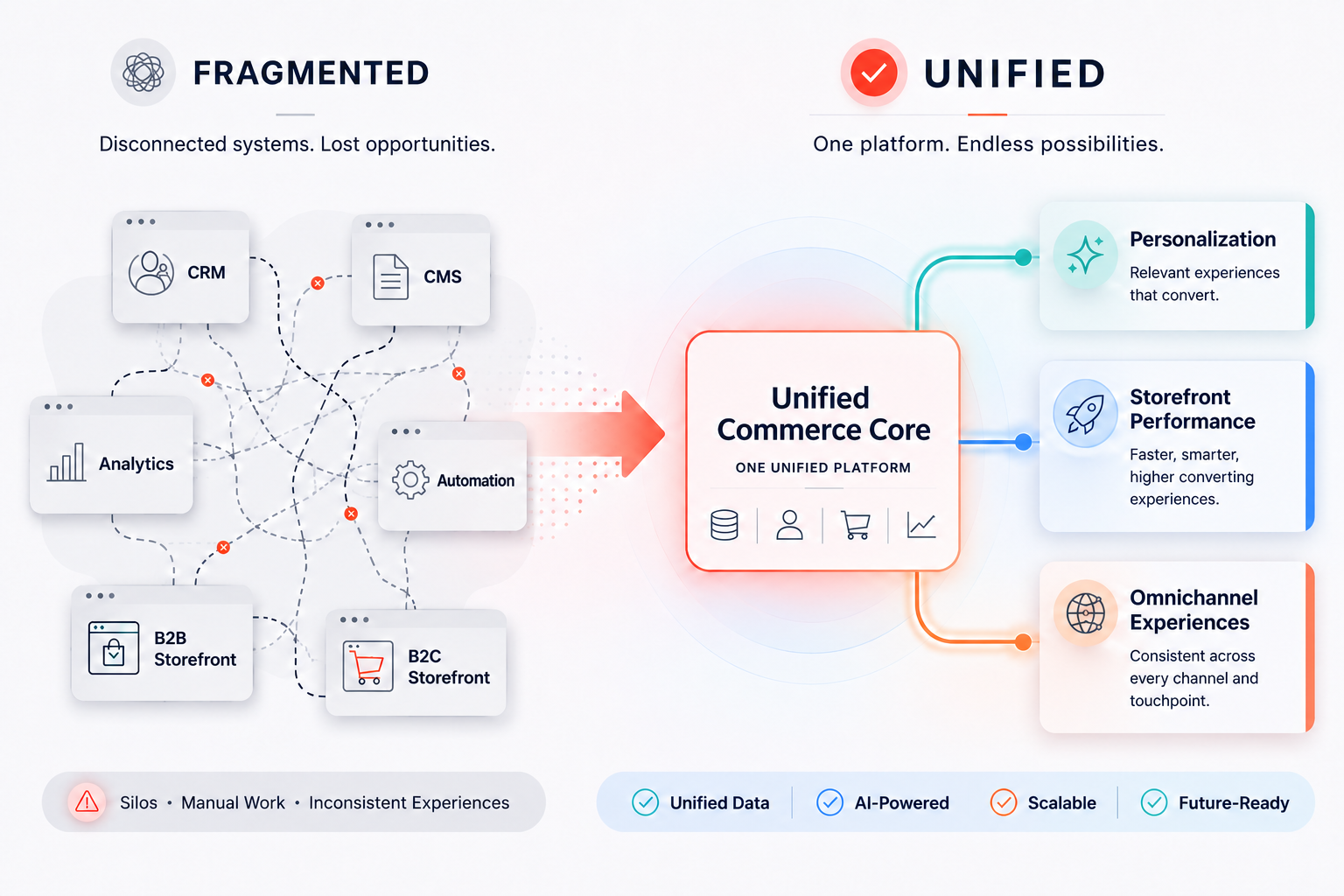
Disconnected commerce systems become one platform for personalized, scalable experiences.
The digital commerce landscape is undergoing one of the most rapid transformations in its history. Buyers across both B2C and B2B markets now expect seamless, personalized, and consistent experiences across every touchpoint. Leading brands are delivering on these expectations and reaping the rewards of greater loyalty, higher engagement, and increased revenue. But for many, delivering these experiences at scale remains a challenge.
The roadblocks are familiar: fragmented data, unclear ROI models, and limited internal expertise. Brand leaders need clear implementation pathways and scalable deployment strategies that balance innovation with oversight. Concerns around over-automation and loss of control remain real, especially in customer-facing experiences.
Organizations are under growing pressure to drive more revenue through digital channels while maintaining agility across geographies, product lines, and customer segments. Scaling modern commerce requires not just ambition but smarter architecture, integrated data, and the right applications of AI.
Despite clear demand and opportunity, several structural challenges make it difficult for organizations to deliver on the promise of digital commerce:
Platform Migration and Modernization Pressures Legacy commerce platforms are increasingly viewed as barriers to agility. With end-of-life systems and rising support costs, many brands are actively planning migrations to modern, cloud-native platforms. But migration is no small feat. These transitions introduce technical complexity, operational risk, and significant investment. For brands looking to evolve quickly, success means choosing platforms that minimize disruption while supporting long-term flexibility, integration, and growth.
AI Implementation and Scaling Complexity Commerce teams see AI as a critical driver of efficiency and personalization - powering content creation, product recommendations, search, and automation. But despite strong intent, many are stuck at early stages of adoption.
Personalization at Scale Implementation Demands Personalization has shifted from a competitive differentiator to a customer expectation. But for most enterprise organizations, delivering personalization across millions of customers, multiple brands, and diverse channels remains out of reach.
Integration and Data Unification Requirements Modern commerce relies on a patchwork of systems - CRM, analytics, CMS, automation - and the challenge is making them work together. Leading brands are prioritizing platforms with strong APIs, built-in connectors, and data activation capabilities to unify the customer journey across teams and channels.
Omnichannel and Multi-Brand Scaling Challenges Brands now operate across multiple geographies, audiences, and channels all while trying to maintain distinct experiences per brand. Scaling requires infrastructure that balances centralization with flexibility, especially in areas like inventory, pricing, and personalization.
These challenges create a clear tension: brands understand what their customers expect, but many still lack the integration, speed, and cross-functional coordination to meet those demands at scale.
Delivering Personalized Commerce Experiences at Scale Consumers have made their preferences clear. According to research from McKinsey, 80% of U.S. adults expect personalization across digital touchpoints, and 76% feel frustrated when brands miss the mark. Leading organizations are seeing 2× growth when personalization is executed well but most still struggle to operationalize. Data silos, legacy systems, and the sheer volume of customer data make it difficult to act in real-time. Brands recognize that automation, AI, and integrated data strategies are essential to delivering personalization at scale — but many are still in the early stages of this journey.
Building Differentiated and High-Performing Storefronts In a post-Covid landscape, your storefront is your flagship. High-performing storefronts are no longer "nice to have" - they are mission-critical for growth. Organizations need storefronts that are fast, flexible, and optimized for conversion. They also need the ability to test, iterate, and evolve experiences quickly. Increasingly, brands are turning away from third-party marketplaces and focusing on their own digital storefronts, where they can control the experience, capture customer data, and maximize margins.
Addressing the Rising Demands of B2B Ecommerce B2B e-commerce represents a monumental $32.1 trillion market opportunity according to data from Capitol One Shopping. Buyers now expect the same self-service convenience they enjoy in B2C - 24/7 ordering, personalization, and seamless purchasing flows. For businesses operating across both B2B and B2C, the challenge is even greater: managing complex business models often requires costly customization or even multiple ecommerce platforms. Without the right foundation, these complexities slow down growth, inflate costs, and limit agility.
We engaged with 100 industry experts to understand how they're rethinking platforms, personalization, and customer experience — and what sets top-performing brands apart.
Enterprise commerce is undergoing a wave of transformation - technically, operationally, and culturally. Brands are adopting AI to enhance personalization, content, and workflows, while also modernizing their platforms to support scalability and integration.
Leaders are focused on activating real-time data, delivering consistent omnichannel experiences, and building more flexible, future-ready architectures. Across interviews, six shared challenges emerged: scaling personalization, balancing B2B and B2C needs, adopting AI with care, modernizing without disruption, and unifying fragmented tech stacks.
80% of ENT commerce orgs are adopting or exploring AI and generative AI.
44.7% of organizations are migrating or planning to in order to scale.
52% of commerce organizations are in early-stage personalization rollout.
62% of organizations manage both B2B and B2C commerce requirements.
83% of organizations prioritize storefront performance & content optimization.
89% of organizations require omnichannel and unified commerce capabilities.
Commerce teams see AI as a critical driver of efficiency and personalization - powering content creation, product recommendations, search, and automation. But despite strong intent, many are stuck at early stages of adoption.
Enterprise commerce organizations are actively implementing or exploring AI and generative AI capabilities, with clear patterns emerging around adoption maturity and strategic focus.
AI Adoption Distribution:
AI is no longer experimental, it's becoming foundational. But most organizations are still in early stages of maturity. Brands should focus on building clear implementation plans with defined use cases, starting where AI can deliver immediate value (like content creation, product search, and automation). The key is balancing innovation with practical ROI and ensuring your AI tools enhance, not replace, the customer experience.
Legacy commerce platforms are increasingly viewed as barriers to agility. With end-of-life systems and rising support costs, many brands are actively planning migrations to modern, cloud-native platforms.
Organizations are migrating or planning on it to meet scalability needs, while all interviewed parties agreed that migration is on their minds.
Migration Patterns:
"We were on a homegrown legacy system, which was very out of date. It was a long time coming, and it was much needed."
Brands should focus on minimizing disruption by selecting platforms that offer proven migration paths, strong support models, and clear business value. Success depends on planning for flexibility, reducing risk, and ensuring new architecture aligns with future growth.
Personalization has shifted from a competitive differentiator to a customer expectation. But for most enterprise organizations, delivering personalization across millions of customers, multiple brands, and diverse channels remains out of reach.
Commerce organizations are in early stage development of implementing personalization.
Personalization Implementation Distribution:
Scaling personalization requires more than intent - it demands unified data, cross-functional coordination, and the right technology. Brands should focus on building a clear roadmap that aligns with their maturity level, prioritizing systems that enable real-time execution and measurable business impact.
B2B e-commerce represents a monumental $32.1 trillion market opportunity. Buyers now expect the same self-service convenience they enjoy in B2C - 24/7 ordering, personalization, and seamless purchasing flows.
Organizations operate dual B2B and B2C models, creating complex platform requirements and unified experience demands.
Commerce Model Distribution:
Managing both B2B and B2C models introduces real complexity across pricing, workflows, and user experiences. Brands should prioritize platforms that can support both models within a single architecture - enabling unified data, efficient operations, and consistent customer engagement.
In a post-Covid landscape, your storefront is your flagship. High-performing storefronts are no longer "nice to have" - they are mission-critical for growth.
Organizations actively focus on storefront performance and AI-driven content creation, with nearly equal emphasis on both areas.
Content and Performance Focus Areas:
As brands compete on experience, AI-driven content and performance optimization are becoming essential. Focus on tools that improve conversion rates, streamline workflows, and personalize storefronts, while supporting faster and more flexible content delivery.
Brands now operate across multiple geographies, audiences, and channels all while trying to maintain distinct experiences per brand. Scaling requires infrastructure that balances centralization with flexibility.
Organizations require omnichannel and unified commerce capabilities, with integration complexity driving platform architecture decisions.
Omnichannel Strategy Distribution:
Omnichannel execution is a top priority, but it comes with complexity. Brands should look for platforms that unify data, maintain consistency across touchpoints, and support real-time updates. Strong integration and operational flexibility are key to delivering seamless experiences.
The six core findings reveal the most urgent challenges and motivations shaping enterprise commerce today - from the rise of AI to the complexity of B2B and omnichannel operations. The five themes that follow highlight how leading brands are responding. These are the areas where teams are investing, experimenting, and building the foundations for future growth. Each theme reflects the real-world decisions that brand leaders are making to scale personalization, connect systems, activate data, and modernize storefront experiences. Taken together, these themes offer a blueprint for scaling smarter — not just with tools, but with cross-functional strategy.
ROI measurement approaches show clear priorities, with 63.3% focusing on conversion and revenue growth, emphasizing revenue-driven optimization over operational metrics.
ROI Measurement Distribution:
The focus on conversion and revenue growth shows that ecommerce leaders are prioritizing tools and strategies that directly impact sales. To drive results, brands should measure performance based on outcomes that tie back to growth, not just operational efficiency.
Marketing-commerce integration maturity is mixed, with 43.8% showing basic or partial integration, indicating partial implementations are more common than comprehensive integrations.
Integration Maturity Distribution:
Many brands are still operating with partial or disconnected systems. To improve performance and customer experience, ecommerce teams should prioritize platforms that support seamless data flow and tighter integration between marketing and commerce systems.
Customer data strategies show strong focus, with 77.3% emphasizing data utilization for personalization, indicating data activation for personalization is the primary concern rather than governance or privacy.
Data Strategy Distribution:
With most brands focused on activating customer data, the priority is shifting from ownership to outcomes. To enable personalization and improve customer experience, teams should invest in platforms that make it easier to unify, access, and act on data in real time.
Multi-brand operational complexity is significant, with 50.5% managing complex multi-brand and multi-market management, creating substantial platform requirements for unified yet flexible brand management.
Scaling Challenge Distribution:
Managing multiple brands and markets adds significant operational complexity. To scale efficiently, ecommerce teams should look for platforms that support centralized control with the flexibility to localize experiences, manage distinct brand needs, and maintain consistency across markets.
Developer priorities emphasize efficiency, with 47.3% focusing on operational efficiency and automation, indicating automation and operational efficiency take precedence over development flexibility.
Developer Experience Distribution:
Improving operational efficiency is a top priority for development teams. Brands should evaluate platforms that reduce manual effort, support faster deployment, and simplify workflows - enabling technical teams to move quickly without sacrificing stability or control.
G2 Research
This report was prepared by G2 AI Custom Research for Adobe.
This research draws on structured interviews with 100 enterprise commerce decision-makers representing a wide mix of roles, industries, and company sizes. Participants included executives, directors, managers, and technical specialists spanning 21.5% Commerce Decision Makers, 20.6% Marketers, 14% E-commerce Leaders, 14% IT Leaders, 11.2% Enterprise Commerce Leaders, 10.3% Commerce Professionals, 8.4% Merchandisers.
The sample reflects a balanced view of the enterprise commerce ecosystem, with organizations ranging from mid-sized firms (100-999 employees) to large global enterprises (1,000+ employees). Industry coverage included retail, B2B services, manufacturing, healthcare, and technology, with a geographic distribution spanning North America.
The analysis of 100 interview transcripts was conducted using AI for semantic understanding, with multi-iteration validation and cross-verification to ensure a 97.0% analysis success rate and confidence scoring. Each transcript was reviewed and formatted by G2's AI Solutions team to inform narrative, context, and clarity.
G2, Transforming Enterprise eCommerce: Strategies for AI Adoption, Personalization, and Platform Modernization, 2025.
Sponsored
Adobe Commerce is a composable ecommerce solution that lets you quickly create global, multi-brand B2C and B2B experiences, all from one cloud-native platform. Use it to deliver personalized, high-performance storefront experiences that boost traffic, conversions, and GMV.
Commission Research
Partner with G2 Research on an original study built from real buyer interviews and structured for AI citation.
Explore more original research, selected from our latest reports.
G2 interviewed 118 IT and security leaders to understand how teams are using AI, what they are buying, and what they require before AI can act. The findings show a market moving from AI that answers to AI that acts, but only on unified data, within governed guardrails, and with proof buyers can audit.
G2 Research's 2026 study of 549 professionals finds 70% of product roadmaps now bend toward AI, but most still have not settled on how to charge for it.
Seventy-three percent of AI pricing professionals favor usage-based or hybrid models, while most accept only a modest premium with proof. See what buyers now expect from AI vendors.