
69%
Fragmentation Is the Operating Reality
Most organizations operate across fragmented, multi-system environments that require manual reconciliation.

The research points to a clear shift in how organizations buy HR, payroll, and HCM technology: the category is moving from feature evaluation to burden evaluation.
The research shows that HR software and payroll software buying decisions are no longer shaped mainly by product features; they are shaped by operating burden. With 69% of organizations still managing fragmented multi-system environments, manual reconciliation has become the starting condition for evaluation.
As a result, when buyers evaluate new HR software or workforce management software, they assess vendors through a broader lens: 78% define value in terms of total cost, including implementation, services, and ongoing support, while 63% say switching is feasible but still time- and resource-intensive enough to raise the bar for change.
In response to this complexity, trust is built through control. 55% feel confident in compliance and security because of internal controls, vendor safeguards, and active oversight, and that same logic carries into automation: 80% are open to AI when human guardrails protect critical decisions.
The implication is clear: organizations will embrace change, but only when the move reduces fragmentation, lowers transition burden, and preserves oversight at every step.
Most organizations operate across fragmented, multi-system environments that require manual reconciliation.
Have not yet consolidated to a unified system, even though most describe one system as the safer way to operate.
Take a broad total-cost view that includes support and services, not just subscription price.
Favor AI automation with human oversight and guardrails for mission-critical decisions.
Most organizations operate across fragmented, multi-system environments that require manual reconciliation. This operational friction is the baseline shaping how buyers evaluate HR and payroll technology—and it is the root cause they feel everywhere else.
Fragmentation is the norm, not the exception: 69% of buyers operate across multi-system environments that require manual reconciliation — a pattern the U.S. Bureau of Labor Statistics identifies as a persistent challenge as HR management roles grow in complexity and a gap that workforce management software is built to close — while only 18% have achieved a unified single-system setup. Another 13% sit in partially unified environments, where software integration cover core workflows but still leave gaps that require oversight and extra effort.
Leaders describe the daily tax of that fragmentation in concrete terms: applicant tracking that does not talk to time and attendance, payroll that does not feed benefits, records re-keyed by hand between tools that were never designed to connect. This is the starting condition that shapes every later decision. Before buyers weigh features or price, they are already absorbing the cost of moving data between systems, and that burden is the lens through which they evaluate anything new.
Manual reconciliation is the daily norm: A majority of leaders rely on manual handoffs to keep disconnected systems in sync: re-entering data, exporting and importing files, and reconciling mismatches by hand. The work is invisible until something breaks.
Only 18% have reached a single system: Just under one in five organizations operate on a unified single-system architecture. The rest are managing the gaps, which means the market is full of buyers actively feeling the pain that consolidation would solve.
Fragmentation is the opening, not an obstacle to work around. If you are evaluating HR management software or payroll software, the goal is not one more tool bolted onto a crowded stack; it is a way out of the reconciliation tax. Keep the destination in view: one unified HR platform, one source of truth, no manual handoffs. The fragmented status quo is the strongest argument for HR software consolidation, and most of the market already feels it.

“The real expense of a fragmented back office is the manual work no one prices at purchase. This research puts numbers to what finance leaders feel every close cycle: disconnected systems are a recurring tax, and consolidating onto one is as much a cost decision as an operational one.”
Buyers consistently describe wanting a single system with one source of truth. They frame consolidation as risk reduction, not convenience: fewer integration points, fewer manual touch points, and a smaller surface area to secure. Those who have not yet consolidated represent the clearest unmet demand in the category.
“So we wanted a solution that would be one platform that covered everything had one app that had all of those pieces in it so the employees didn't have to learn different systems and jump from one system to another to get their daily work done.”
— Chief Information Officer, Nonprofit Social Services
When leaders describe what they actually want, they do not list features. They describe a single system. One platform, one app, one source of truth, so employees and administrators stop jumping between tools and reconciling data by hand.
More than four in five HR and payroll leaders — 82% — have not yet consolidated to a unified system, representing the clearest pool of unmet demand in the category. Only 18% are already operating on a unified single-system architecture. The demand for consolidation is not primarily about reducing software costs or simplifying the vendor landscape — it is about cutting implementation burden, eliminating the gaps where data goes wrong, and reducing the operational risk that fragmentation creates. Operating multiple HR and Payroll systems could produce a measurable cost every business should be aware of before taking any buying decision.
One source of truth is the goal: Leaders want HR, payroll, time, and benefits to live in one place so data does not have to be moved, matched, or trusted across systems. A single source of truth is the architecture buyers aspire to, even when they have not reached it yet.
Unified architecture is framed as risk reduction: Buyers connect consolidation directly to lower risk: fewer integration points that can break, fewer manual touch points where errors enter, and a smaller surface area to secure and audit. This reframes architecture from an IT preference into a board-level risk decision.
Treat consolidation as a risk decision, not a feature list. A single unified system, one database underpinning HR, payroll, time, and benefits, removes manual reconciliation, shrinks the data surface to secure, and eliminates integration breakpoints. Those are the proof points to look for, and the journey matters as much as the destination: ask how the move itself will be de-risked.

“For years, HR and payroll were bought feature by feature. What stands out here is that leaders are done managing the seams between systems. The teams that feel in control are the ones who stopped reconciling by hand and moved to a single source of truth, and that is a people decision as much as a technology one.”
Compliance and security were on every leader's mind, but confidence is uneven. Those who feel secure credit layered controls and oversight, while others feel actively exposed by fragmented data spread across disconnected systems. The confidence that exists is built on manual effort—exactly what a unified architecture would remove.
“And then I think that having a lot of disparate systems like my current company does that are semi-connected or connected, but there's always going to be the risk of an integration not functioning properly.”
— Research Participant, Global Manufacturing
Roughly half of leaders, 55%, feel confident in compliance and security because they have formal controls, vendor safeguards, and active oversight in place. That confidence is not passive, though. Another 27% still feel exposed by manual processes and disconnected tools, while only 18% mainly rely on IT teams, vendors, or outside experts to carry the load. HR analytics tools are increasingly part of how organizations close this gap through better reporting and audit visibility.
Confidence is strongest where organizations combine audits, access controls, and dedicated governance with reliable system reporting — practices aligned with the NIST Cybersecurity Framework for managing sensitive data across interconnected systems. By contrast, leaders working across fragmented or semi-connected systems describe greater day-to-day risk, especially around data exposure and integration failures. In practice, trust depends less on assuming a vendor has it covered and more on whether the operating model closes manual and architectural gaps.
Confidence rests on manual controls, not architecture: The 55% who feel secure credit formal controls, vendor safeguards, and active oversight: human and procedural effort layered on top of the systems. That confidence is real but fragile, because it depends on continuous manual vigilance rather than a clean underlying foundation.
Fragmentation is the named source of exposure: Leaders tie their exposure directly to disconnected data: sensitive information spread across systems that do not talk to each other, with every integration a potential point of failure or leak. Consolidating data reduces the surface area to secure and the places it can go wrong.
Compliance and security are universal concerns, but most teams are managing them with manual effort layered over fragmented data. The structural answer is a unified, single-database architecture: one governed source of truth that shrinks the attack surface, keeps data clean for accurate reporting, and turns compliance from a constant manual chase into a built-in property of the system.
“I'm fairly confident that we're meeting our compliance requirements, but it's something that requires constant attention rather than something we can assume is handled automatically. That confidence comes from regular audits, established payroll controls, compliance reviews, system reporting, and staying current with regulatory changes that affect payroll and HR operations.”
“The finding that stays with me is that most leaders' confidence in compliance is manual. It holds because people watch it constantly, not because the systems handle it. That is a heavy load to carry, and it is why moving to one unified system reads as risk reduction, not convenience.”
Buyers have moved past subscription price as the measure of value. They evaluate through a total-cost-of-ownership lens that includes implementation, services, and ongoing support. Dedicated human support is expected as part of the value equation, not an optional add-on.
“What matters most is continued HR support. And payroll support, dedicated specialists that know my account, know the nature of our business, know the history of, you know, any issues or things that may come up.”
— People Operations Director
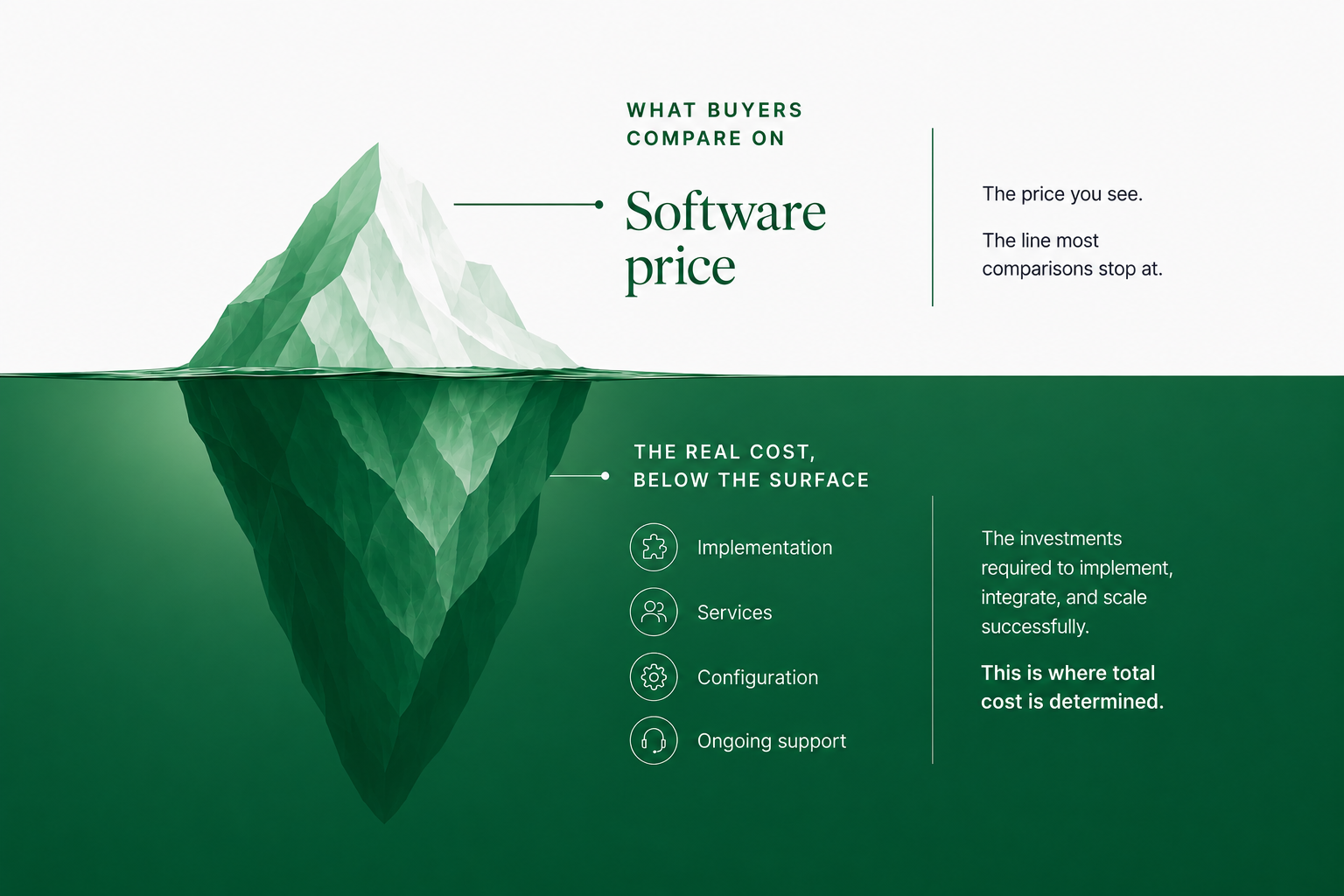
Value decisions are anchored in total cost, not sticker price: 78% take a broad ownership view that includes implementation, services, and ongoing support. Only 5% evaluate primarily through subscription cost, while 17% explicitly treat dedicated human support as part of the value equation when comparing HR and payroll platforms. Notably, this challenges a common assumption in the category: that buyers ignore services and support when comparing vendors. They do not. They have learned, often the hard way, that the effort to implement and run a platform is where the real cost lives. And alongside cost, they expect a relationship: 77% want dedicated, continuous human support, specialists who know their account, rather than a ticket queue. For buyers, software is only part of what they are buying; they are buying the effort it takes off their plate and the partner who stays after go-live.
Buyers are not just pricing software, they are pricing the effort and risk around it. Leaders with a broader TCO lens consistently factor in integrations, internal labor, and optimization over time, while a small minority remain budget-first and subscription-led. In practice, this raises the bar for vendors: competitive pricing alone is not enough without visible service depth and continuity of support.
Total cost of ownership defines value for most: 78% judge value across the full lifecycle: license, implementation, services, configuration, and the internal resources needed to run and optimize the platform. The contract price is treated as one line item, not the decision.
Dedicated human support is expected, not a bonus: 77% expect a continuous, dedicated partnership with named specialists who understand their business, as part of the value equation. Live, knowledgeable support is increasingly a baseline requirement rather than a differentiator.
Evaluate on total cost of ownership and the support relationship, not subscription price. Make the all-in math explicit: implementation, services, and ongoing support alongside the license. Expect dedicated, continuous human support to be a core part of the value, not an add-on, and ask vendors to price it transparently.
“For me, total cost of ownership goes well beyond the software subscription. The license fee is important. But it's often only one component of the overall investment. I would look at implementation costs, consulting, and configuration services.”
“For us, that cost of ownership goes well beyond the subscription fee. We look at implementing your services, integrations and, ongoing support and the internal resources required to maintain and optimize the platform over time.”
“The clearest signal here is that buyers no longer equate price with value. Nearly eight in ten weigh total cost of ownership, the implementation, the services, the ongoing support, over the subscription line. On that math a fragmented stack carries a recurring tax in manual work, and consolidating onto one well-supported system is as much a finance decision as an operational one.”
Switching HR and payroll platforms is seen as feasible but high-stakes. Most say a switch is manageable yet time- and resource-intensive, with the fear centered on business disruption—the immediate impact on pay and benefits if anything goes wrong. Migration confidence is what tips a feared project into an acceptable one.
“The biggest hesitation holding me back is the immense amount of work it takes to make a change, the cost to make a change, the hours to make a change, the investment of time, will we get it right? All of those concerns.”
— HR and Payroll, Transportation
Switching HR and payroll platforms is not seen as impossible, but it is seen as high-stakes. 63% say a switch is manageable yet highly time- and resource-intensive, and another 26% describe it as a major burden and a high-risk disruption; only 11% are casually open to change. The dominant tension is not whether switching can be done, but whether organizations can absorb the operational load. The weight comes from what these systems touch: payroll software and HR software reach every employee, so any transition carries the risk of disrupting pay, benefits, and trust. Part of the weight is time: leaders describe transitions running several months across data migration, configuration, testing, training, and change management, and every additional system to integrate stretches that timeline. Buyers will move, but only when the upgrade clearly outweighs the strain, and only with confidence that the migration itself will be handled. This is precisely where dedicated implementation support converts a feared project into a manageable one. Even buyers willing to switch need a compelling payoff in automation, compliance, or benefits administration functionality to justify the disruption.
The stakes are what make switching feel risky: Because HR and payroll systems touch every employee, leaders frame a switch around business disruption: the immediate, visible impact on people's pay and benefits if anything goes wrong. The fear is less about effort than about getting it wrong.
Migration confidence is the unlock: The bar to change is high, but it is not fixed. Buyers move when they believe the transition will be managed: a clear plan, a dedicated team, and continuity through go-live. Confidence in the migration is what tips a feared project into an acceptable one.
Switching is a barrier, but the barrier is risk, not impossibility. Make migration confidence a condition of the deal: require a structured implementation program, a dedicated team that owns the move, and explicit continuity safeguards for pay and benefits. Timeliness is part of the value: the faster the implementation, the sooner you reach ROI and everyday usage, and integrating multiple systems stretches that timeline and adds complexity. Favor systems with decisioning logic, where you set the rules and keep human oversight while the technology automates work consistently across the organization. De-risking the move matters as much as choosing the destination.
Buyers are open to AI and automation when human oversight stays in place. They welcome automation with guardrails, but draw the line at high-stakes, money-touching decisions. Trust in automation is inseparable from trust in the data underneath it—a unified source of truth is what makes automation feel safe.
“I need it proven to me first. And I would have to have the vendor prove it to me with certainty because people don't like their paychecks being messed up.”
— Human Resources Manager
Buyers are not resistant to automation. They are conditional about it: 80% are open to AI and automation in HR and payroll as long as human oversight and guardrails stay in place; only 15% remain broadly hesitant, and just 5% would confine it to low-risk tasks - a pattern G2 explored further in the AI Adoption Under Control research. The line they draw is at high-stakes, mission-critical decisions, especially anything that touches pay, where leaders want approval workflows, explainability, audit trails, and proof before they hand over control. What is easy to miss is how much that trust depends on the underlying architecture: automation feels far safer when it runs on one governed source of truth rather than reconciling across disconnected systems. On a unified foundation, security and automation reinforce each other; on a fragmented one, every automated step inherits the risk of the data beneath it.
The line is high-stakes, money-touching decisions: Leaders welcome automation for efficiency but want a human in the loop wherever a mistake would hit pay, benefits, or compliance. They ask for explainability, audit logs, and approval steps before trusting automation in consequential workflows.
Unified architecture is what makes automation safe: Trust in automation is inseparable from trust in the data underneath it. A single, governed source of truth means automated steps act on clean, consistent data, so security and automation reinforce each other instead of compounding fragmentation risk.
Adopt AI human-in-the-loop, not autonomous: approval workflows, exception handling, audit trails, and role-based controls. Start in high-value, lower-stakes use cases to build trust. Then weigh the architecture: automation is only as trustworthy as the data it runs on, and a unified single source of truth is what makes it safe to say yes in the workflows that matter most.
“AI would play a role as well. But primarily as a decision support tool. It will proactively, like, identify risks, highlight trends, surface opportunities, and provide recommendations with a high degree of transparency and explainability. Importantly, it would help people make better decisions rather than replace human judgment.”
“However, we will require strong controls explainability, audit logs, human approval for consequential decisions, and clear rules preventing sensitive HR data from being used improperly or be leaked.”

“HR and payroll leaders are increasingly looking for software that automates decisions for them. They want to reduce the operational burden created by disconnected systems. They want data consolidation that enables full-solution automation through decisioning logic, reducing manual work, improving accuracy and giving organizations greater confidence in their data. When information flows through a single software, teams can automate routine processes, spend less time reconciling systems and focus more on supporting employees and driving business outcomes.”
Because many organizations operate across fragmented systems with manual reconciliation, buyers assess solutions through a broad total-cost lens that includes support and services. Operational friction does not stay contained at the workflow level; it directly shapes commercial evaluation and perceived value.
For buyers: price the operating burden into every comparison. Integration friction, manual reconciliation, and service dependency are part of a platform's real cost, not just its feature list.
Security confidence and openness to automation both depend on preserved oversight. Buyers trust current environments through internal controls and safeguards, and they extend that same logic to AI by accepting automation only when human guardrails remain in place.
For buyers: hold any new system, and any AI inside it, to the standard you already trust: transparency, approvals, auditability, and a human in the loop.
Although most buyers say switching is feasible, they also describe it as time- and resource-intensive. Combined with a broad total-cost mindset, this suggests that willingness to change exists, but only when the benefits clearly outweigh transition burden and ongoing support demands.
For buyers: make any switch contingent on strong onboarding, implementation support, and proof that total operating burden actually drops over time.
It is the dominant operating model: 69% of buyers report working across fragmented multi-system setups that require manual reconciliation. Only 18% say they have a unified single-system environment, while 13% describe their setup as only partially unified.
No. 78% take a broad total-cost view that includes implementation, services, and ongoing support. Only 5% evaluate primarily through subscription cost, showing that buyers are pricing the full effort and risk around the software, not just the license.
Most do not see switching as impossible. In fact, 63% say it is manageable, but highly time- and resource-intensive. Another 27% describe it as a major burden and high-risk disruption, while just 11% say they are readily open to change when the upgrade is clearly worth it.
Confidence is built more through controls than through simplicity. 55% say they feel confident because they have internal controls, vendor safeguards, and active oversight in place. At the same time, 27% still feel exposed due to manual processes and disconnected tools, which shows the limits of control-heavy workarounds.
Buyers are broadly open, but only under clear guardrails. 80% favor AI and automation when human oversight protects critical decisions, compared with 15% who remain hesitant to trust AI in mission-critical workflows and 5% who would limit it to low-risk use cases.
Fragmented environments create risk through manual processes and disconnected tools, not through any single point of failure. 27% of HR and payroll leaders say they still feel exposed despite having controls in place — a direct consequence of patching together systems that weren't designed to share data. The risk is compounded when reconciliation depends on human intervention at every step.
Fragmented environments create risk through manual processes and disconnected tools, not through any single point of failure. 27% of HR and payroll leaders say they still feel exposed despite having controls in place — a direct consequence of patching together systems that weren't designed to share data. The risk is compounded when reconciliation depends on human intervention at every step.
Most go well beyond the subscription price. 78% factor in implementation costs, services, ongoing support, and the resource burden of eventually switching. Only 5% evaluate on licensing cost alone. Total cost of ownership for HR software includes everything from onboarding and training to the operational overhead of running the system day-to-day — and the exit cost if it doesn't work out.
Because the complexity of implementation and ongoing compliance doesn't end at go-live. 77% of HR and payroll leaders want dedicated, continuous support from specialists who know their account — not a ticket queue. 17% explicitly factor this into their vendor comparison as a value driver, not a nice-to-have. For high-stakes workflows like payroll and compliance, the quality of human support is part of the product.
You are already paying a fragmentation tax in manual work, reconciliation, and risk. Compare platforms on how much of that burden they remove, not on feature checklists. That is the problem most worth solving.
A single unified system, one database for HR, payroll, time, and benefits, cuts implementation burden, shrinks the compliance and security surface, and removes the gaps where data goes wrong. Weigh it as a risk decision, not a feature upgrade.
Switching is feared because HR and payroll touch every employee. De-risk it directly: require a structured implementation program, a dedicated team that owns the move, and explicit continuity safeguards for pay and benefits.
Do the all-in math: implementation, services, configuration, and ongoing support, not just the subscription line. Expect continuous, named support to be part of the value, not an upsell.
Keep humans in control of high-stakes decisions and let automation prove its accuracy in lower-stakes workflows first. Then weigh the architecture: automation is only as trustworthy as the source of truth it runs on.
This research draws on 211 in-depth interviews with business professionals representing a wide mix of roles, industries, and company sizes.
The interviews covered switching burden and transition risk, total cost framing and support expectations, system architecture, integration friction and operational control, and compliance and security confidence models. The conversational format allowed respondents to discuss their actual practices rather than select from preset options, surfacing nuance that closed-ended surveys typically miss.
Respondents included business professionals across technology, financial services, healthcare, manufacturing, and retail. All participants were selected for their direct experience with software evaluation, implementation, integration, and operational risk management. Company sizes ranged from small businesses to large enterprises.
The analysis of 211 interview transcripts was conducted using AI for semantic understanding, with multi-iteration validation and cross-verification to ensure analysis quality. Each transcript was independently reviewed by G2's AI Custom Research team to inform narrative, context, and clarity.
G2 Research, June 2026
This article was originally published in June 2026 and updated in August 2026.
G2 is the world's largest and most trusted software marketplace.
Sponsored
Paycom provides a single software for HR and payroll, eliminating the burden of managing multiple disconnected systems.
With Paycom, you get one unified platform that handles payroll, HR, talent acquisition, talent management, and time and labor management—all in a single database. Join the organizations that have eliminated manual reconciliation and reduced operational risk.
Paycom provides a cloud-based HCM solution delivered as a single application, eliminating the need for multiple systems and manual data transfers. With industry-leading employee self-service, Paycom empowers organizations to reduce administrative burden while improving accuracy and compliance.
This research was commissioned by Paycom. G2 maintains full editorial independence.
Commission Research
Partner with G2 Research on an original study built from real buyer interviews and structured for AI citation.
Explore more original research, selected from our latest reports.
How 249 enterprise leaders are balancing AI opportunity with governance, revealing organizations that have largely established control frameworks but now face growing friction between oversight requirements and deployment speed.
G2 Research's 2026 study of 549 professionals finds 70% of product roadmaps now bend toward AI, but most still have not settled on how to charge for it.
G2 research from 1,392 interviews finds 77% of professionals embed AI in workflows, while governance, readiness, and work redesign lag behind.