
85%
G2 AI Custom Research · Salesforce · 108 Interviews · Apr 1, 2026
From SaaS to AI: Why Go-To-Market Models Are Being Rewritten
How AI-selling companies are changing the way they price, sell, and run revenue operations — and why no single team owns revenue anymore.
108
in-depth interviews with senior leaders at AI-selling companies
85%
of companies use hybrid pricing
56%
run hybrid go-to-market motions
23%
still manage hybrid pricing manually
Key Research Findings
The business model that built SaaS is not working for AI. For two decades, software companies sold the same way: charge per seat, sell through reps, close annual contracts, book predictable recurring revenue. AI is breaking that model — the cost of running AI is variable, not fixed, and customers expect to pay for what they actually use. This is not just a pricing problem, a go-to-market problem, or a revenue operations problem. It is all three at once, caused by the same shift from predictable SaaS economics to the variable economics of AI.
Three big changes are happening at once: pricing has become more complex, selling now runs through multiple paths, and revenue is no longer owned by a single team.
Pricing has become more complex. Eighty-five percent of companies use hybrid pricing, combining two or more pricing models for a single offer, and 57% added consumption pricing for AI in the last 24 months. Single-model pricing is disappearing.
Selling runs through multiple paths. Fifty-six percent run hybrid GTM, combining self-service and sales-led motions — but 57% of those hybrid companies are still majority sales-led by customer volume. Self-service often works as lead generation, not a standalone channel.
Usage data is driving growth, but the systems have not caught up. Fifty-nine percent of companies that discussed the topic use product usage data to drive expansion and 51% trigger outreach on usage signals, yet 23% still manage hybrid pricing manually and 21% run self-serve and sales-led on separate systems. Revenue now spans four teams and four tools, with no single platform connecting them.
The companies doing well in the AI transition are not the ones with the most advanced AI product. They are the ones rebuilding how they price, sell, and run revenue to match how AI actually works.
57%
Added Consumption Pricing for AI in the Last 24 Months
56%
Run Hybrid Go-To-Market Motions
59%
Of Companies That Discussed the Topic Use Usage Data to Drive Expansion
23%
Still Manage Hybrid Pricing Manually
Chapter 01
Pricing Has Become More Complex
Single-model pricing is on the way out. Hybrid pricing — where companies combine subscription with usage-based, tiered, or one-time pricing — is now the default for AI-selling companies. This section looks at what the shift means, what is driving it, and why a single pricing approach no longer works for most AI products.
Key Finding
Hybrid pricing is now the default for AI-selling companies
Hybrid Pricing Adoption
85%
of companies use hybrid pricing, combining two or more pricing models for a single offer
The pricing strategy that built SaaS does not fit the economics of AI. For two decades, software was sold on a fixed annual fee per user, with costs that stayed predictable as the customer grew. AI has broken that predictability — inference costs vary by query, and a customer running heavy workloads cannot reasonably pay the same as one running light workloads. Subscription has not disappeared: 95% of companies still use it as their pricing foundation, but 73% now layer usage-based pricing on top, 45% sell tiered packages, and 13% include one-time or perpetual purchases. Only 15% still use a single pricing model, and many of them described plans to add usage components within 12 months. A B2B software GTM leader captured the change: “The biggest difference AI has introduced is moving from a static, seat-based model to something more usage and value-driven.” A healthcare SaaS revenue strategy leader traced the longer arc: “It used to be perpetual plus maintenance. It’s moved to ARR. And now it’s trying to move to hybrid pricing — so it’s recurring plus outcome-base or consumption-base.”
Key Takeaways
01
Subscription is the base, usage is the layer: 95% keep subscription as the foundation and 73% add usage-based pricing on top.
02
Single-model pricing is shrinking: only 15% use pure subscription, usage, or one-time pricing.
03
AI economics drive the shift: one heavy-inference customer can cost more to serve than 10 light users combined.
Strategic Implication
Pricing is now a system, not a decision. Hybrid pricing is an operating capability that requires billing, metering, quoting, contracts, and finance to work in coordination. Companies treating hybrid as a packaging update accumulate manual workarounds faster than they can resolve them.
Pricing models in use (% of companies, not mutually exclusive)
95%
Subscription
Subscription
95%
Usage-based
73%
Tiered packages
45%
One-time / perpetual
13%
Key Finding
The companies that run hybrid pricing well share a set of operational choices
Hybrid Pricing in Practice
Knowing that hybrid pricing is the default does not tell you how to run it well. The most successful hybrid structure uses a fixed subscription to anchor the customer relationship and a usage component to capture value as consumption grows. Companies that inverted this — leading with pure usage — reported more difficulty with forecasting, renewals, and contract negotiations. Leaders also made pricing legible to customers with usage estimators, monthly dashboards, commit-based discounts, and usage caps that prevent bill shock, and they designed pricing within the constraints of the quote-to-cash stack they actually had rather than adopting models their billing systems could not support. An AI-powered SaaS product leader described the base-plus-usage model in practice: “Customers pay a base subscription for core access, and then they incur additional costs based on usage, like the number of AI interactions or tickets. It lets customers start small with a predictable cost and then scale as their usage grows.” Where systems fall short, the strain is immediate — as one AI-enabled consulting revenue leader noted: “When you make a tailor-made, custom-made solution sale that is nonstandard … the billing process is not able to capture it.”
Key Takeaways
01
Anchor with subscription, capture upside with usage: subscription protects forecasting while usage captures expansion without a new contract cycle.
02
Make pricing predictable: estimators, dashboards, commit-based discounts, and usage caps address customer pushback on unpredictability.
03
Design for the infrastructure you have: adopting models the billing system can't support forces finance into manual workarounds.
04
Plan for pricing to keep evolving: companies are already moving to outcome-based and per-workflow components.
Strategic Implication
Hybrid pricing is not a destination but an ongoing set of decisions. Companies that built their pricing systems for flexibility are ready for the next iteration; companies that built for the current model will be doing another round of manual workarounds in 12 months.
Key Finding
More than half of companies moved AI pricing to consumption in the last two years
Consumption Pricing for AI
57%
introduced consumption pricing for their AI product in the last 24 months
The shift to consumption pricing is the most concrete pricing change in the AI market today. For most companies it represents a structural change in how revenue is forecasted, how sales is incentivized, and how customers are billed. Consumption pricing breaks the predictability that anchored SaaS forecasting: finance must model variable consumption curves and sales must forecast usage growth with limited visibility. The 38% who have not moved to consumption use a mix of fixed approaches — gating AI behind premium tiers, flat add-ons with fixed allowances, or including AI free in the base product — but respondents across all three described growing pressure to move toward consumption as usage grows. The remaining ~5% adopted consumption pricing for AI earlier than the 24-month window covered here, so the figures reconcile to the full sample: 57% (consumption in the last 24 months) + 38% (still on fixed pricing) + ~5% (earlier consumption adopters). One B2B workflow SaaS product leader described the ripple effect: “The shift to usage-based pricing tied to consumption instead of just seats has changed how we package, how we sell, and the forecast.” Others cautioned against overcorrecting — a healthcare SaaS revenue strategy leader noted: “We want consistent revenue. We don’t want variable revenue. So consumption-based or outcome-based pricing could be quite volatile. You really need a middle path.”
Key Takeaways
01
Consumption introduces new forecasting complexity: real-time usage metering tied to forecasting is still immature, leaving finance on spreadsheet models that go stale within weeks.
02
It changes how companies sell, not just how they charge: quotas, ramp schedules, and renewal conversations all have to be rebuilt.
03
The windows reconcile: 57% adopted consumption in the last 24 months, 38% remain on fixed pricing, and ~5% adopted consumption earlier — together the full sample.
Strategic Implication
Consumption pricing without consumption-grade infrastructure is a liability. Adopting the model is the easy part; building the metering, billing, and forecasting to support it is the hard part. Companies that move faster than their infrastructure accumulate revenue leakage, disputes, and forecast unpredictability.
Key Finding
The market has not converged on a single way to monetize AI
AI Monetization Approaches
Three years into widespread AI adoption, no single monetization model has won. Usage-based pricing leads at 51%, premium plan inclusion follows at 41%, and 27% of companies still include AI free in the base product. Thirty-two percent deploy two or more monetization methods at once, segmenting their customer base by what each segment will accept. The 27% giving AI away free fall into two camps: companies where AI is a feature enhancement rather than a standalone product, and companies facing competitive pressure where AI has become table stakes. One CRM SaaS product leader admitted: “A lot of our AI usage is still currently unbilled. And we’re just absorbing the cost.” A healthcare SaaS revenue leader put the table-stakes shift plainly: “Doctors went from viewing it as a premium to now they view it as almost like table stakes. Core needs to be in our offerings in order for us to be competitive.” A note on the two headline figures: the 51% usage-based figure here reflects current adoption across all timeframes, while the 57% on consumption pricing captures only what was introduced in the last 24 months — the two measure different windows and are not meant to sum.
Key Takeaways
01
One in four companies gives AI away free, and often not by choice — for many it is a temporary competitive response, not a strategy.
02
Multi-model monetization reflects market uncertainty: 32% run two or more methods to serve different segments.
03
51% (usage-based, all timeframes) and 57% (consumption adopted in the last 24 months) measure different windows — read them separately.
Strategic Implication
The companies winning today are not the ones with the cleverest monetization model. They are the ones with enough operational flexibility to support multiple models simultaneously.
AI monetization methods in use
51%
Usage-based pricing
Usage-based pricing
51%
Premium plan inclusion
41%
Included free in the base product
27%
Seat-based add-on
9%
Chapter 02
Selling Runs Through Multiple Paths
Customers no longer come in through one door. Hybrid GTM, combining self-service and sales-led motions, has overtaken pure sales-led as the most common approach. But having both paths is not the same as running hybrid revenue — most companies still generate most of their customer volume through sales, even when self-service is available.
Key Finding
Hybrid GTM has overtaken pure sales-led as the most common approach
GTM Model Distribution
For most of the last decade, the AI-selling category was overwhelmingly sales-led — AI products required configuration, integration, data-privacy review, and trust-building conversations that did not lend themselves to self-service. That has changed. Fifty-six percent of AI-selling companies now run hybrid GTM. Pure sales-led has dropped to 39% and pure product-led growth (PLG) remains a small minority at 5%. The shift is real, but building hybrid GTM is one thing and running revenue through hybrid motions is another. As one construction-tech GTM leader put it: “We’ve gone back and forth between sales led and PLG motions, but right now we’re sales led. The minimum price is about $40,000.” A B2B software GTM leader described the blurred reality: “Self-service is about 55% while sales assisted is about 45%. There is no path that is truly 100% one way anymore. Even the enterprises often start with some product usage or trial.”
Key Takeaways
01
Pure product-led remains rare for AI: only 5% operate with no sales team, because AI selling needs a human presence for privacy, configuration, and procurement.
02
The hybrid split varies widely: few companies sit at a true 50/50 — hybrid is a spectrum, not a single model.
03
Orchestration is the challenge: running two motions creates channel conflict, attribution disputes, and inconsistent pricing.
Strategic Implication
The direction is clear — hybrid GTM is winning — but the hard part is orchestration. Channel conflict, attribution disputes, and inconsistent pricing across paths are challenges single-motion companies never face.
GTM model distribution (% of companies, mutually exclusive · n=108)
Hybrid GTM (PLG + SLG)56%
Sales-led only39%
Product-led only5%
Key Finding
Three operational archetypes show up repeatedly in the data
Hybrid GTM in Practice
The topline statistic that 56% run hybrid GTM masks significant variation in how the motion operates. Three archetypes emerge, each with different economics and required capabilities. The right hybrid motion depends on product complexity, average deal size, and target segment — and companies often copy another company's balance without adapting it, ending up with a motion that fits neither their product nor their customer. A B2B SaaS GTM leader described the segmented pattern: “Smaller customers tend to move faster and more self-serve, while mid-market and enterprise usually go through a more structured sales process with demos, pilots.” Others walked self-serve back entirely — as one construction-tech GTM leader recounted: “We had PLG, but also sales led … We’ve gotten rid of that project-based pricing though, and now we’re a subscription-based price. The minimum price is $40,000. So now you need to go through our sales team in order to try the product.”
Key Takeaways
01
Archetype 1 — Sales-assisted self-serve: self-serve handles acquisition; sales engages at usage thresholds. Uncommon for AI because deal sizes tend to be larger.
02
Archetype 2 — Segmented motion: SMB goes self-serve, mid-market and enterprise go through sales. The most common hybrid pattern in the sample.
03
Archetype 3 — Self-serve as lead generation: the majority of self-described hybrid companies; self-serve qualifies prospects but sales closes the meaningful deals.
Strategic Implication
Leaders figured out which archetype fit their business before building the supporting infrastructure. Counting self-serve trial users as hybrid customers can create misleading revenue forecasts and misaligned incentives.
Key Finding
The dominant path to hybrid runs through a sales-led learning phase first
GTM Evolution Path
The path to hybrid GTM is not symmetrical. Among the 87 companies that discussed their history, 82% started sales-led and added self-service or PLG once the product and segment were well understood. Only 16% went the other direction, starting with PLG and layering sales on after hitting limits. The asymmetry matters: companies that tried PLG first often had to walk it back because, without sales qualification, the wrong customers converted and churned quickly or never activated. One event-planning AI founder traced the arc: “Our first customers were probably word-of-mouth, and just from our salespeople. But now they come in through our WordPress, and AI does a lot of the heavy lifting in terms of sales.” For many, the self-service aspiration stays just that — a leadership-development SaaS product leader admitted: “We’ve tried to be self-service, but it’s totally sales-led.”
Key Takeaways
01
Sales-led is the on-ramp, not a dead end: it is the phase where a company learns who the right customers are and what value the product delivers.
02
Premature PLG produces churn; late PLG concedes self-service revenue to competitors — timing is the strategic question.
03
Only 2% launched with both motions at once.
Strategic Implication
PLG is a phase-2 capability, not a phase-1 strategy. For most AI-selling companies the path to PLG runs through a sales-led learning phase; the question is not whether to add PLG, but when.
GTM evolution path (% of companies who discussed history · n=87)
82%
of companies that discussed their GTM history started sales-led, adding PLG or self-service later
Started sales-led, added PLG later82%
Started PLG, added sales later16%
Launched with both motions2%
Key Finding
Most hybrid companies are still majority sales-led by actual customer volume
Customer Volume Vs. Motion
Hybrid GTM is now dominant in headcount and infrastructure, but revenue mix tells a more nuanced story. Among the 56% running hybrid GTM, 57% generate the majority of their customer volume through sales-led paths, and only 8% are majority self-service. Within hybrid companies, 13% have a roughly balanced split and ~22% are still figuring out their volume split — meaning 79% are predominantly sales-led or unsettled. Websites, demo requests, and free-trial paths look like self-service but route qualified prospects to sales for the actual transaction. A B2B SaaS GTM leader described exactly how the “self-service” surface feeds sales: “They come in inbound through our website, and they use CTAs — request a demo, request a contact, request a quote, request a free trial. Those then come into the business development team, go through qualification, and then get sent to the sales team.” Another B2B SaaS GTM leader put the split bluntly: “About 70% to 80% comes from mid-market and enterprise deals handled by sales. The remaining 20% to 30% is more self-serve.”
Key Takeaways
01
Self-service often functions as a lead-gen funnel: the customer experience is hybrid, but the operational reality is sales-led.
02
Only 8% of hybrid companies are majority self-service by customer volume.
03
Building self-service capability has been faster than shifting the actual customer mix — a multiyear journey.
Strategic Implication
The strategic question is whether the gap closes over time, or whether self-service in AI permanently functions as a feeder for sales rather than a standalone channel.
Customer-volume split within hybrid GTM companies (n=108)
57%
of hybrid GTM companies are still majority sales-led by actual customer volume
Predominantly sales-led or still settling their volume split
79%
Majority self-service or a roughly balanced split
21%
Key Finding
AI is not a blanket PLG enabler
PLG Motion for AI
32%
use a PLG motion specifically for their AI product (among those who discussed it)
The industry conversation has implied AI is a natural accelerant for product-led growth. The reality is more nuanced. Among companies that discussed PLG for AI specifically, only 32% report a dedicated PLG motion for their AI product. The other 68% sell AI through the same sales-led channels as their core product. AI features require explanation, integration, and trust that self-service alone rarely provides. Where PLG works for AI, it works for simple, visible-value use cases where the value is immediately clear without configuration. An HR software AI product leader named the barrier directly: “The reception on the AI features has been good, but it’s more around navigating concerns from clients about how we’re using their data in the AI.” Where it does work, a B2B software GTM leader explained why: “Self-service is actually the entry point — so asking to try the product quickly and see the value without any sort of heavy traction.”
Key Takeaways
01
AI complexity and trust barriers limit self-service adoption, especially for enterprise buyers focused on data handling and accuracy.
02
AI accelerates PLG for simple, individual-user, integration-light use cases and reinforces sales-led for complex, multiuser ones.
03
Companies selling multiple AI products often run different motions for different use cases.
Strategic Implication
PLG for AI is a use-case decision, not a company-level decision. The right question is not whether to use PLG for AI, but which AI use cases lend themselves to self-service and which require sales.
Key Finding
Channel breadth is now closer to enterprise scale than mid-market
Channel Mix
Most AI-selling companies run three or four channels simultaneously: inside sales (88%), field sales (73%), self-serve (69%), and channel partners (65%). Each channel reaches a different customer type, and the complexity is the cost of growth in a market where no single segment is large enough to support a single channel. Channel partners remain core for 65% of companies despite years of direct-to-customer discussion — they matter most in enterprise deals with pre-existing relationships, regulated industries, and international expansion. A note on the numbers: “self-serve” as a channel (69%) includes secondary surfaces such as renewals, upgrades, free trials, and expansion used even by companies whose primary acquisition motion is sales-led. That is why the 69% channel figure exceeds the 61% of companies that actually run a self-service GTM path (pure PLG plus hybrid). Revenue distribution across channels varies widely — one B2B software sales leader described the split: “Self-serve website takes about 45%. Our channel partners is about 20%. Then the rest is for field sales and inside sales.” For some, digital channels now outpace direct selling entirely, as an enterprise print-software demand-gen leader observed: “Growth marketing, demand gen produces more deals, more open opportunities than sales at our company. So sales is not directly going out there. It is growth.”
Key Takeaways
01
Multichannel is the reality: most companies run 3–4 channels at once.
02
Channel partners remain essential for segments where direct sales cannot make the unit economics work.
03
The 69% self-serve channel figure exceeds the 61% with a self-service GTM path because channel use counts renewals, upgrades, trials, and expansion at sales-led companies too.
04
The orchestration problems are consistent: channel conflict, attribution disputes, and pricing inconsistency across channels.
Strategic Implication
Channel orchestration is now a top-three GTM capability. Breadth is no longer a differentiator — the companies running three to four channels well have disciplined routing rules, clear attribution, and pricing consistency.
Channels in use (% of companies, not mutually exclusive)
88%
Inside sales
Inside sales
88%
Field sales
73%
Self-serve
69%
Channel partners
65%
Chapter 03
Revenue Is No Longer Owned by a Single Team
Usage data is becoming a key input for growth — it drives expansion decisions, signals customer intent, and triggers engagement. But the systems behind it are still fragmented. Revenue now spans four teams working in different tools, with no single view of the customer. This section looks at both sides: where usage data is driving growth, and where the operational gaps are slowing companies down.
Key Finding
Usage data has moved from product analytics to revenue operations
Usage Data and Expansion
59%
of companies that discussed the topic use usage data to identify expansion and upsell opportunities
In the last two years, usage data has moved from product analytics into revenue operations. Fifty-nine percent of companies that discussed the topic use product usage data to drive expansion decisions, and 51% trigger customer outreach based on usage signals. Where customer success once relied on quarterly business reviews, leading companies now use real-time signals to prompt action: an account approaching plan limits triggers an upsell, a sudden usage drop triggers a retention conversation, a feature-adoption spike triggers enablement. A B2B workflow SaaS product leader described the signals that matter most: “Spikes in usage, engagement drops, and then drop off — those usually trigger the outreach.” A construction-tech GTM leader described the payoff: “If they’re coming up on their project limit, it’ll trigger something for our customer success team to reach out. It’s allowed us to be more proactive instead of reactive.”
Key Takeaways
01
51% trigger customer engagement based on usage signals such as approaching plan limits, usage spikes, or engagement drops.
02
8% want to use usage data for expansion but lack the infrastructure to capture it at the needed granularity.
03
Winners treat usage data as a revenue signal, not an engineering metric — that shift separates companies capturing expansion from those leaving it on the table.
Strategic Implication
Usage data is becoming the most important input to revenue motion. Only companies with the right telemetry and integrations can close the loop from product event to revenue action — and as more competitors operationalize usage signals, the gap is becoming a competitive disadvantage.
Key Finding
Ambition has outpaced the systems that need to support it
Revenue Operations Fragmentation
23%
still manage hybrid pricing through manual processes — spreadsheets, manual invoicing, and ad hoc adjustments
The ambition to run hybrid pricing and hybrid GTM has outpaced the systems that support it. Twenty-three percent of companies still manage hybrid pricing manually — spreadsheets, manual invoicing, and ad hoc reconciliation — and 21% run self-service and sales-led revenue on separate systems entirely. The cost shows up in delayed invoices, billing disputes, revenue leakage, and the time finance teams spend reconciling what should have been automated. Existing billing tools were designed for predictable seat counts, not usage that varies by customer and month. A B2B software product leader summed up the core problem: “The fragmentation between these systems and the billing and the products — they can’t all sync properly, perfectly in real time.” A government-fleet software sales and marketing leader described the day-to-day cost: “Pricing and billing are both handled very manually. Bills don’t get out the door on time.”
Key Takeaways
01
Spreadsheets run the show: each new pricing model added increases the manual workload geometrically.
02
21% run self-serve and sales-led revenue on separate systems, forcing workarounds and manual reconciliation.
03
The SaaS-era stack was built for predictable recurring revenue, not usage-based pricing, AI credits, hybrid packaging, or multichannel attribution.
Strategic Implication
Revenue infrastructure used to be a back-office function that did not constrain growth. In the AI era it does: companies whose billing and quoting systems support hybrid and consumption models can move quickly to capture revenue; companies whose systems cannot are limited to what their infrastructure supports.
Key Finding
Revenue is now a shared responsibility across four functions
Distributed Revenue Ownership
In the SaaS model, revenue ownership had a clear structure: sales owned the deal, customer success owned renewals, and finance owned billing. The AI model has broken that structure. Revenue now flows continuously rather than annually, usage signals matter as much as contract terms, and billing has moved from back-office to real-time operations. The typical AI-selling company has revenue data scattered across four systems — sales owns pipeline in the CRM, product owns usage in analytics, finance owns billing in the ERP, and customer success owns renewals in a separate tool — with no platform connecting them. An AI venture studio founder described the drag this creates: “The accounting was definitely causing almost a bottleneck, because I had to do all this stuff manually.” A healthcare SaaS revenue strategy leader described the fragmented view: “They’re looking at different slices of data. It could be in Power BI, Excel, NetSuite, or other tools. No, they’re not typically all looking at the same thing.”
Key Takeaways
01
The typical revenue lifecycle spans four disconnected systems of record: Sales → CRM (pipeline); Product → Analytics (usage); Finance → ERP (billing); Customer Success → Health tool (renewals).
02
Four functions, four tools, zero end-to-end view: when a customer journey crosses these boundaries, critical information is lost in the handoffs.
03
Usage signals never reach sales and billing changes never reach customer success — producing missed expansion, surprise churn, and eroded trust.
04
The data exists somewhere in the company; it is just not where the team that needs it can see it.
Strategic Implication
Companies need a unified revenue engine that connects product usage signals, pricing logic, billing execution, and expansion triggers in a single platform, so no team is operating in the dark.
Key Finding
Four failure patterns translate fragmentation into measurable cost
The Operational Cost of Fragmentation
Distributed revenue ownership and fragmented systems are not just governance issues — they translate into measurable operational costs that accumulate quietly across the year. The interview data surfaces four specific failure patterns that companies with fragmented revenue operations consistently describe. Each is small in isolation; together they represent meaningful revenue leakage and operational drag at scale. An IoT + SaaS product leader described the expansion cost: “The information loss happens later in the stage where … when sales is going back to upsell and cross sell, they don’t always know whether a customer’s had a bad experience.” A connectivity/telecom revenue leader described the billing cost: “One of my biggest friction points is when customers believe they are overcharged or incorrectly billed even when on the system it’s accurate … This case has required investigations across multiple systems and often manual reviews.”
Key Takeaways
01
Missed expansion: usage signals sit in product analytics but never reach customer success or sales in time to act.
02
Surprise churn: engagement drops show up in product data but are invisible to retention teams using SaaS-calibrated health scores.
03
Billing disputes: pricing gets quoted in sales but calculated in finance, and the math does not always match.
04
Delayed invoicing: when the math can't be automated, finance becomes the bottleneck — close cycles extend and invoices go out late.
Strategic Implication
Invoicing lag often becomes a retention issue, not just a finance issue. In companies running hybrid pricing on fragmented systems, these disputes are routine rather than exceptional.
Strategic Patterns
Cross-Cutting Themes
PATTERN 01
AI Economics Break SaaS Predictability
The cost of delivering AI is variable, not fixed. That single shift is what drives hybrid pricing, consumption models, and the move away from flat per-seat billing.
PATTERN 02
Capability Outpaces Reality
Companies build hybrid pricing and hybrid GTM capabilities faster than they shift actual behavior. 56% run hybrid GTM, yet most are still majority sales-led by customer volume.
PATTERN 03
Fragmentation Is the Common Tax
Manual pricing, separate systems, and four-team revenue ownership all stem from the same root: an infrastructure gap between what AI-era commerce requires and what SaaS-era tools were built for.
Sponsored
Transform Revenue Operations for the AI Era With Agentforce Revenue Management
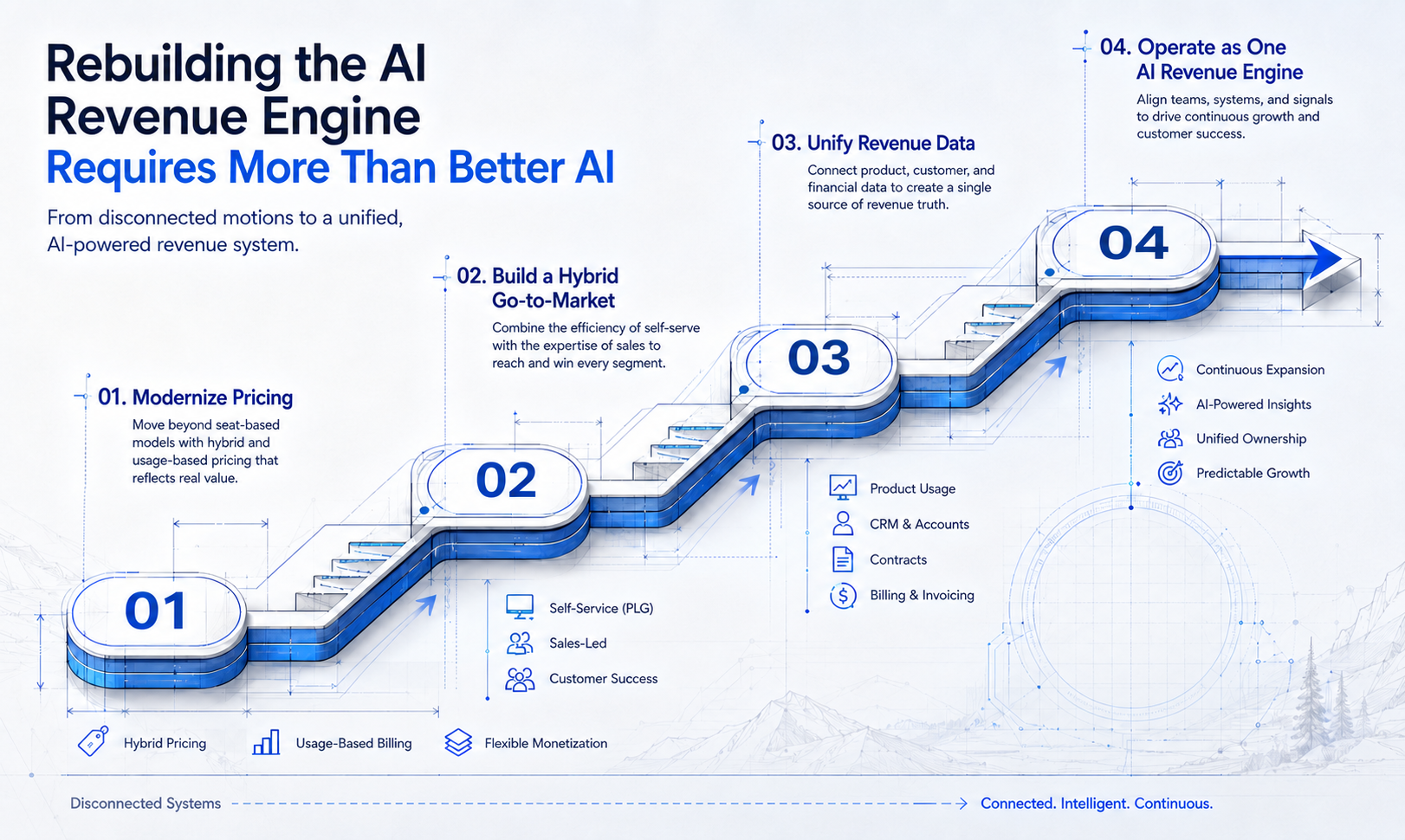
This report makes one thing clear: revenue complexity is outpacing the systems built to manage it. Hybrid pricing is now the default, selling runs through multiple channels, and the gap between what companies sell and what their systems can execute is growing.
This is exactly the problem Agentforce Revenue Management is built to solve. It unifies the entire revenue lifecycle — pricing, quoting, contracting, and billing — across every channel, with AI and agents executing inside governed workflows at every step. Agents enforce the rules behind every transaction across any channel, so what you sell is exactly what you invoice, deals stay intact from quote to contract to billing, and every action is auditable.
Better buying and selling experiences – When pricing, quoting, contracts, and billing live on one platform, sellers move faster and buyers get a consistent experience across every channel.
Shorter sales cycles, faster time to cash – Agentforce Revenue Management keeps deals intact from quote to contract to billing, removing the handoffs between sales, finance, and legal that slow deals down.
Higher revenue per customer – Expansion and renewal opportunities are surfaced before they are missed, so growth is captured across the full customer lifecycle.
About Agentforce Revenue Management
Agentforce Revenue Management is Salesforce's complete AI revenue platform, running pricing, quoting, contracting, and billing across every sales channel with AI and agents embedded in every step. Built natively on the Salesforce Platform, it eliminates the fragmentation between sales and finance so what you sell is exactly what you invoice, at any scale.
This research was commissioned by Salesforce. G2 maintains full editorial independence.
FAQ
Common Questions
Question 01
What Share of AI-Selling Companies Now Use Hybrid Pricing?
Eighty-five percent combine two or more pricing models for a single offer. Subscription remains the foundation for 95% of companies, with 73% layering usage-based pricing on top. Only 15% still use a single pricing model.
Question 02
Is Product-Led Growth Replacing Sales for AI Products?
No. Fifty-six percent run hybrid GTM, but 57% of those are still majority sales-led by customer volume and only 5% are pure PLG. Self-service most often functions as lead generation that feeds sales rather than a standalone revenue channel.
Question 03
How Many Companies Moved AI Pricing to Consumption Models?
Fifty-seven percent introduced consumption pricing for their AI product in the last 24 months. Another 38% still charge for AI through fixed approaches such as premium tiers or flat add-ons, and the remaining ~5% adopted consumption pricing earlier than that 24-month window. Together, 57% + 38% + ~5% account for the full sample, so the figures reconcile to 100%.
Question 04
Why Do the 51% and 57% Pricing Figures Differ?
They measure different time windows. The 51% usage-based figure reflects current adoption across all timeframes, while the 57% consumption-pricing figure captures only what was introduced in the last 24 months. The two are not meant to sum or to be compared directly.
Question 05
Why Is Revenue Operations Becoming a Competitive Constraint?
Twenty-three percent of companies still manage hybrid pricing manually and 21% run self-serve and sales-led revenue on separate systems. Revenue now spans four teams and four tools with no single platform connecting them, producing missed expansion, surprise churn, billing disputes, and delayed invoicing.
Question 06
What Did the Research Cover?
108 in-depth interviews with senior leaders at mid-market AI-selling companies ($10M–$250M ARR), each 30–40 minutes, coded across 15 structured themes covering pricing, go-to-market motion, channel mix, usage-data practices, and revenue operations.
Question 07
How Does This Report Define Its Key Terms?
The report applies a consistent framework so the percentages reflect the same underlying concepts at every reference. Sales-led growth (GTM strategy): customers need to engage with a sales representative to make a purchase. Product-led growth (GTM strategy): acquisition, conversion, and expansion driven with product usage as the primary growth engine. Hybrid GTM: a model that combines product-led/self-service paths and sales-led motions. Self-service purchasing (transaction method): how a customer completes a purchase, directly in-product or online without sales. Hybrid pricing: selling multiple pricing models for a single offer or product (for example, subscription, usage-based, and one-time). Usage signals: a measurable indicator of how a customer is using a product that suggests intent, value, or opportunity.
Strategic Recommendations
What this means for you
01
Critical
Design for Hybrid Pricing From Day One
With 85% of companies now combining multiple pricing models, single-model billing infrastructure is a liability. Build or adopt revenue systems that natively support subscription, usage-based, tiered, and one-time pricing in combination, not just in isolation.
02
Critical
Treat Usage Data as a Revenue Asset, Not an Analytics Metric
Fifty-nine percent of companies that discussed the topic use usage data for expansion, but operationalization is uneven. Invest in telemetry and signal-to-action pipelines that automatically trigger engagement based on usage patterns, closing the loop from product event to revenue action.
03
High
Unify the Revenue Stack Before Scaling the Motion
With 21% running self-serve and sales-led on separate systems, GTM orchestration is held back by infrastructure. Unify CRM, billing, usage metering, and customer success data into a single revenue engine before expanding into new channels or motions.
04
High
Build for Sales-Led Today, Hybrid Tomorrow
Eighty-two percent of companies started sales-led before adding self-service. Rather than aspiring to replace sales with PLG, augment sales with self-service paths that qualify, onboard, and expand small customers while sales focuses on high-value accounts.
05
Moderate
Align Revenue Ownership Across Four Functions
Revenue now spans sales, product, finance, and customer success. Create a shared operating model — shared data, shared dashboards, shared KPIs — so every team sees the same customer revenue lifecycle and expansion opportunities stop falling through the handoffs.
G2 Research
This report was produced by G2 AI Custom Research and commissioned by Salesforce. The research and analysis are editorially independent.
About this Research
This research draws on 108 in-depth interviews with senior leaders across AI-selling companies representing a wide mix of roles, industries, and company sizes. Interviews ran approximately 30 to 40 minutes and covered pricing strategy, go-to-market motion, channel mix, usage-data practices, and revenue operations infrastructure. The study focused on established mid-market SaaS companies ($10 million–$250 million ARR) actively selling AI products or AI-enabled services. Respondents held a mix of senior roles — revenue strategy leaders, product leaders, founders, GTM operators, and sales executives — all screened for direct involvement in pricing, go-to-market, or revenue operations decisions. Industry coverage included B2B SaaS, healthcare technology, construction technology, workflow automation, HR software, and financial services, among other enterprise categories. Every transcript was systematically coded across 15 structured themes, with multi-iteration validation and cross-verification to ensure analysis quality and consistency.
Commission Research
Make Your Category the Next G2 Report.
Partner with G2 Research on an original study built from real buyer interviews and structured for AI citation.
More from G2 Research
Keep Reading
Explore more original research, selected from our latest reports.
Full Report
State of AEO 2026: AI Outpaces Measurement
G2 research from 153 B2B marketing decision-makers finds AI answer engines are becoming buyers' first research step faster than marketing teams can measure their visibility and impact.
18 min read
Full Report
70% of Product Roadmaps Are Shifting Toward AI. Monetization Is Still Unresolved.
G2 Research's 2026 study of 549 professionals finds 70% of product roadmaps now bend toward AI, but most still have not settled on how to charge for it.
19 min read
Full Report
AI Adoption in Sales Performance Management
How enterprise sales performance management teams adopt, validate, govern, and scale AI.
8 min read